
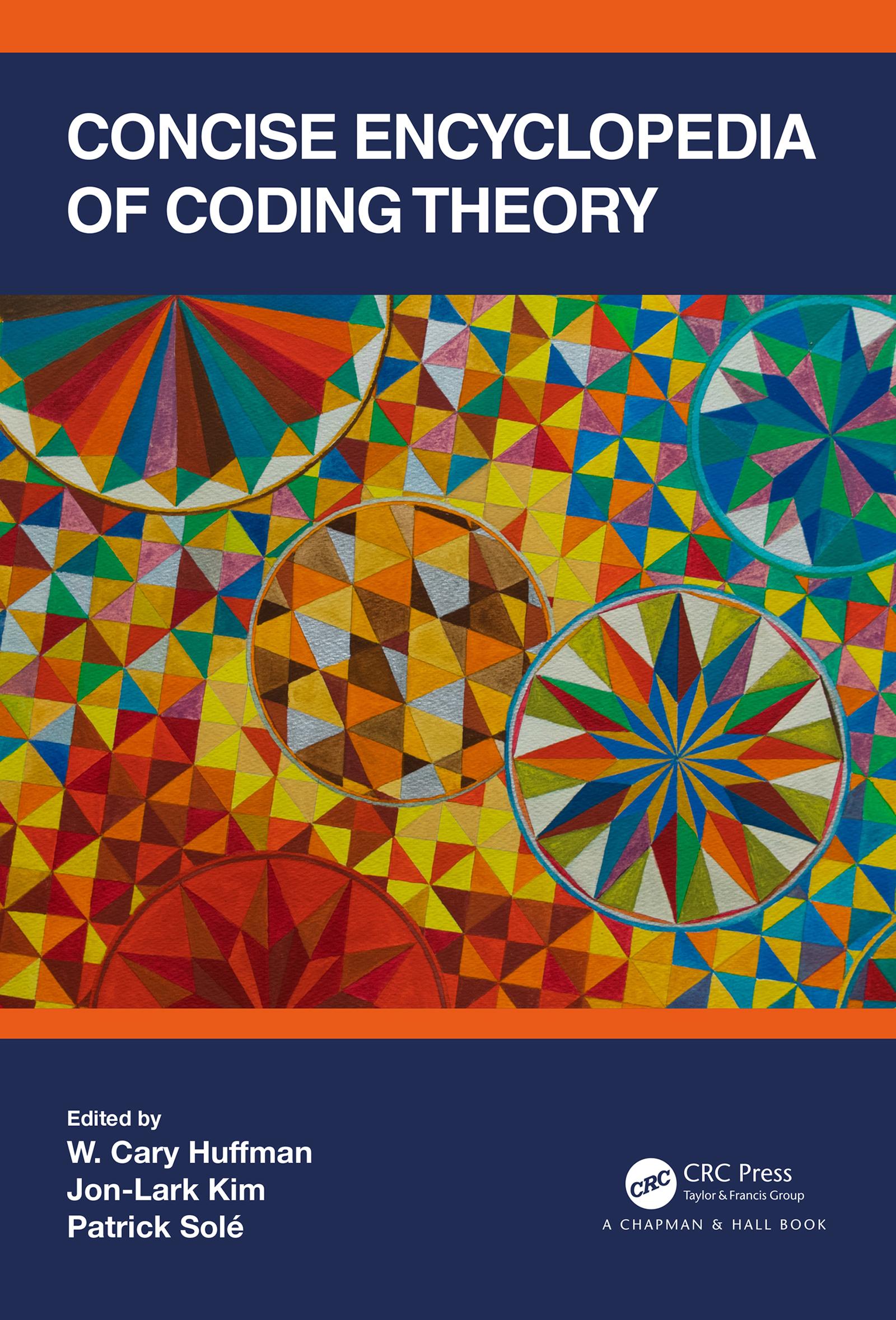
Most coding theory experts date the origin of the subject with the 1948 publication of A Mathematical Theory of Communication by Claude Shannon. Since then, coding theory has grown into a discipline with many practical applications (antennas, networks, memories), requiring various mathematical techniques, from commutative algebra, to semi-definite programming, to algebraic geometry.
Most topics covered in the Concise Encyclopedia of Coding Theory are presented in short sections at an introductory level and progress from basic to advanced level, with definitions, examples, and many references.
The book is divided into three parts:
Part I fundamentals: cyclic codes, skew cyclic codes, quasi-cyclic codes, self-dual codes, codes and designs, codes over rings, convolutional codes, performance bounds
Part II families: AG codes, group algebra codes, few-weight codes, Boolean function codes, codes over graphs
Part III applications: alternative metrics, algorithmic techniques, interpolation decoding, pseudo-random sequences, lattices, quantum coding, space-time codes, network coding, distributed storage, secret-sharing, and code-based-cryptography.
Features
- Suitable for students and researchers in a wide range of mathematical disciplines
- Contains many examples and references
- Most topics take the reader to the frontiers of research
Betal nemt med kort, Klarna, Apple Pay eller Google Pay. Ikke tilfreds? Du har altid 14 dages fortrydelsesret. Læs mere i vores vilkår. Har du spørgsmål, så send os en mail på hello@memmo.org.
Memmo gør det nemmere at studere – uanset hvor du er i verden. Hos os samler du dine kursusbøger og smarte studieværktøjer ét sted: resuméer, quizzer, podcasts og flashcards. Og så er der Ted, din studieven, der svarer på alt, du undrer dig over. Over 50 000 studerende studerer allerede her – bygget til at hjælpe dig med at lære hurtigere og stresse mindre.