
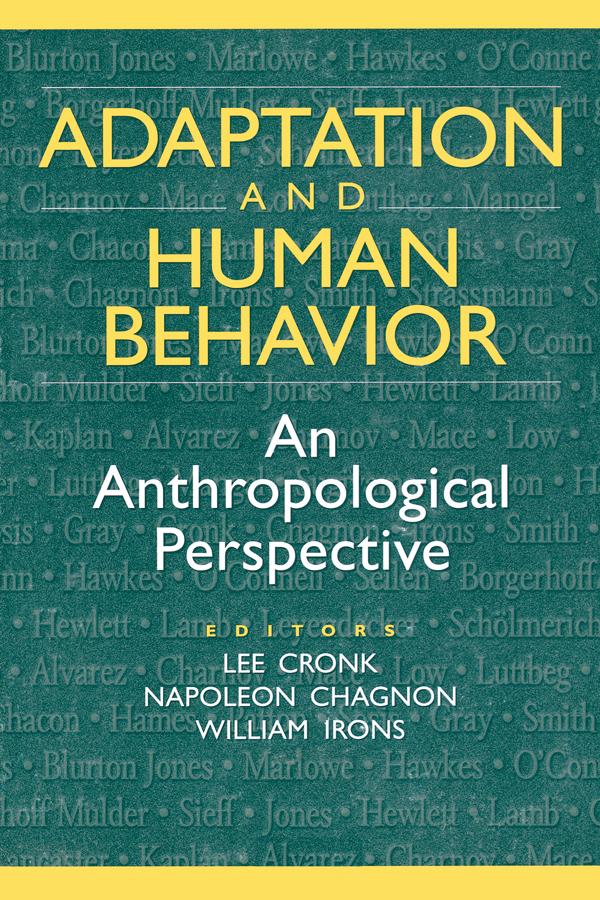
This volume presents state-of-the-art empirical studies working in a paradigm that has become known as human behavioral ecology. The emergence of this approach in anthropology was marked by publication by Aldine in 1979 of an earlier collection of studies edited by Chagnon and Irons entitled Evolutionary Biology and Human Social Behavior: An Anthropological Perspective. During the two decades that have passed since then, this innovative approach has matured and expanded into new areas that are explored here.
The book opens with an introductory chapter by Chagnon and Irons tracing the origins of human behavioral ecology and its subsequent development. Subsequent chapters, written by both younger scholars and established researchers, cover a wide range of societies and topics organ-ized into six sections. The first section includes two chapters that provide historical background on the development of human behavioral ecology and com-pare it to two complementary approaches in the study of evolution and human behavior, evolutionary psychology, and dual inheritance theory. The second section includes five studies of mating efforts in a variety of societies from South America and Africa. The third section covers parenting, with five studies on soci-eties from Africa, Asia, and North America. The fourth section breaks somewhat with the tradition in human behavioral ecology by focusing on one particularly problematic issue, the demographic transition, using data from Europe, North America, and Asia. The fifth section includes studies of cooperation and helping behaviors, using data from societies in Micronesia and South America. The sixth and final section consists of a single chapter that places the volume in a broader critical and comparative context.
The contributions to this volume demonstrate, with a high degree of theoretical and methodological sophistication--the maturity and freshness of this new paradigm in the study of human behavior. The volume will be of interest to anthropologists and other professions working on the study of cross-cultural human behavior.
Betal nemt med kort, Klarna, Apple Pay eller Google Pay. Ikke tilfreds? Du har altid 14 dages fortrydelsesret. Læs mere i vores vilkår. Har du spørgsmål, så send os en mail på hello@memmo.org.
Memmo gør det nemmere at studere – uanset hvor du er i verden. Hos os samler du dine kursusbøger og smarte studieværktøjer ét sted: resuméer, quizzer, podcasts og flashcards. Og så er der Ted, din studieven, der svarer på alt, du undrer dig over. Over 50 000 studerende studerer allerede her – bygget til at hjælpe dig med at lære hurtigere og stresse mindre.