
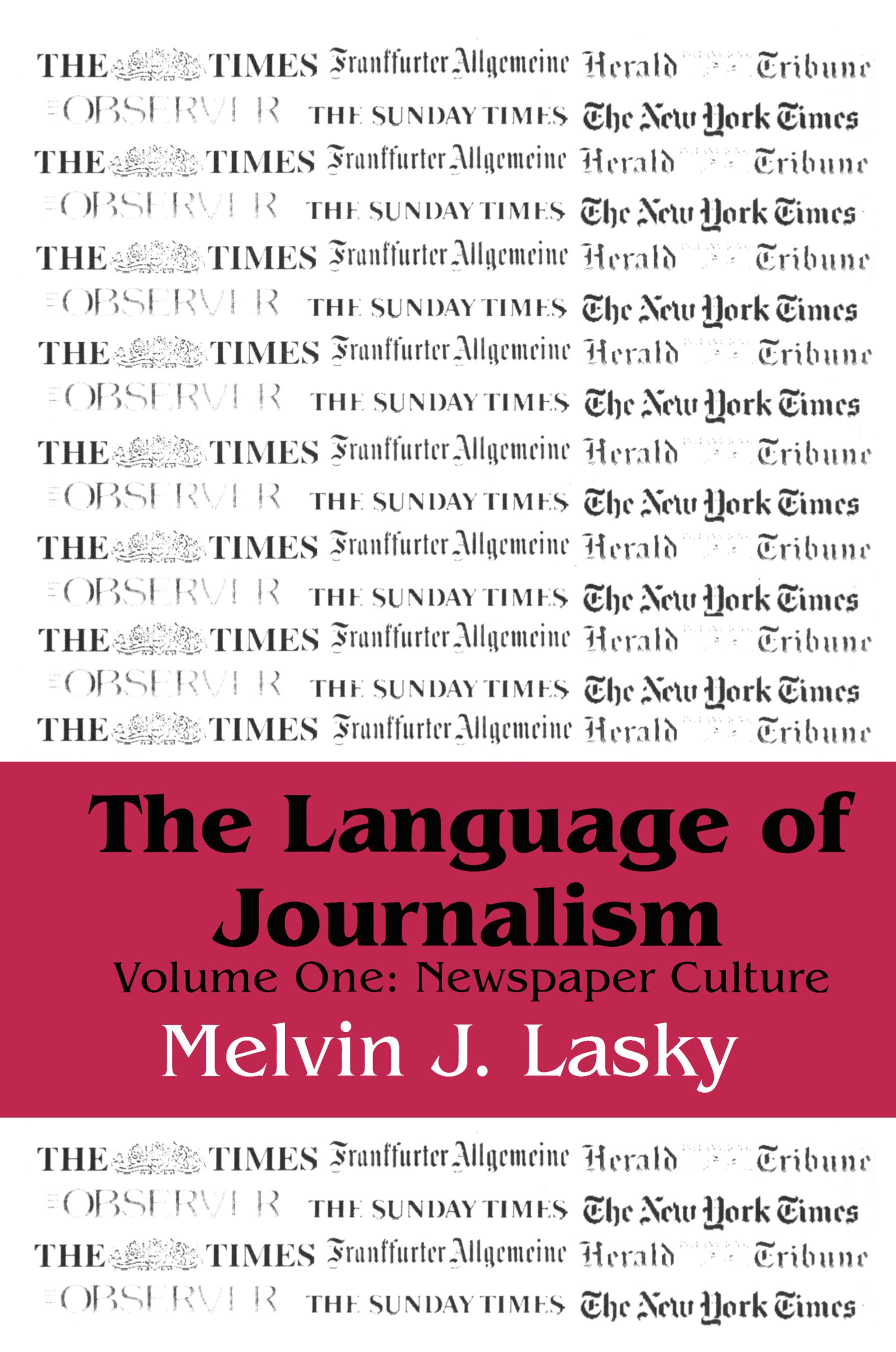
The newspaper is to the twentieth century what the novel was for the nineteenth century: the expression of popular sentiment. In the first of a three-volume study of journalism and what it has meant as a source of knowledge and as a mechanism for orchestrating mass ideology, Melvin J. Lasky provides a major overview. His research runs the gamut of material found in newspapers, from the trivial to the profound, from pseudo-science to habits of solid investigation.
The volume is divided into four parts. The first attacks deficiencies in grammar and syntax with examples from newspapers and magazines drawn from the German as well as English-language press. The second examines the key issues of journalism: accuracy and authenticity. Lasky provides an especially acute account of differences between active literacy and passive viewing, or the relationship of word and picture in defining authenticity.
The third part emphasizes the problem of bias in everything from racial reporting to cultural correctness. This is the first systematic attempt to study racial nomenclature, identity-labeling, and literary discrimination. Lasky follows closely the model set by George Orwell a half century earlier. The final section of the work covers the competition between popular media and the redefinition of pornography and its language. The volume closes with an examination of how the popular culture both influenced and was influential upon literary titans like Hemingway, Lawrence, and Tynan.
Betal nemt med kort, Klarna, Apple Pay eller Google Pay. Ikke tilfreds? Du har altid 14 dages fortrydelsesret. Læs mere i vores vilkår. Har du spørgsmål, så send os en mail på hello@memmo.org.
Memmo gør det nemmere at studere – uanset hvor du er i verden. Hos os samler du dine kursusbøger og smarte studieværktøjer ét sted: resuméer, quizzer, podcasts og flashcards. Og så er der Ted, din studieven, der svarer på alt, du undrer dig over. Over 50 000 studerende studerer allerede her – bygget til at hjælpe dig med at lære hurtigere og stresse mindre.