
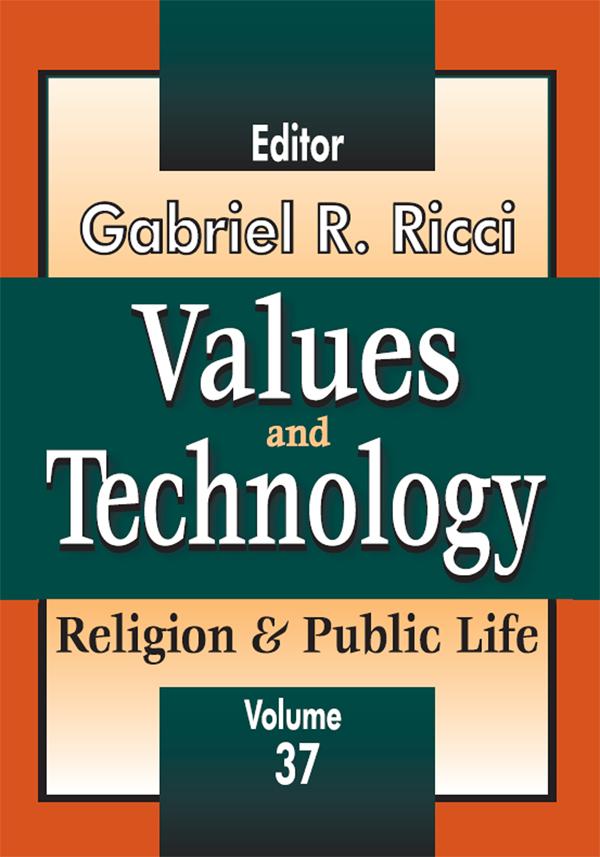
In 1749 Jean-Jacques Rousseau's Discourse on the Arts and Sciences, surprised leading Enlightenment thinkers who had enthusiastically upheld the positive benefits of humanity's technological advance. Voltaire, who celebrated the ends of civilization, mocked Rousseau's praise for an original creative state of nature in which man enjoyed an optimum level of freedom.
Given the unprecedented intrusion of technology into our lives, the question raised by Rousseau's critique may be even more pertinent. In this volume of Religion and Public Life contributors address some of the challenges to conventional morality brought on by the technological augmentation of the social structure. John Barker's essay explores how Luciano Floridi's philosophy of technology has complicated the conventional way of determining what ought to receive moral consideration. Fani Zlatarova provides a practical guide for incorporating ethical components into teaching computer technology.
Grant Havers explores the controversies surrounding the biogenetic explosion through an examination of the competing philosophical perspectives and Christopher Vassilopolos examines the science-based justification for taking life. Gabriel R. Ricci looks at recent political history in the United States in order to highlight the sometimes uneasy relationship between science and social policy. Volume 37 is a welcome addition to the acclaimed Religion and Public Life series.
Betal nemt med kort, Klarna, Apple Pay eller Google Pay. Ikke tilfreds? Du har altid 14 dages fortrydelsesret. Læs mere i vores vilkår. Har du spørgsmål, så send os en mail på hello@memmo.org.
Memmo gør det nemmere at studere – uanset hvor du er i verden. Hos os samler du dine kursusbøger og smarte studieværktøjer ét sted: resuméer, quizzer, podcasts og flashcards. Og så er der Ted, din studieven, der svarer på alt, du undrer dig over. Over 50 000 studerende studerer allerede her – bygget til at hjælpe dig med at lære hurtigere og stresse mindre.