
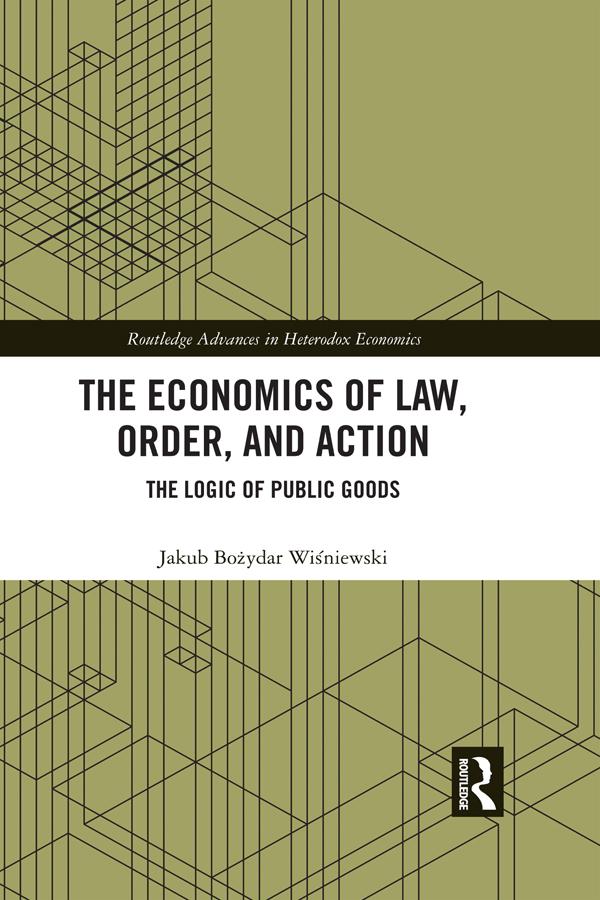
According to the standard position of the economic mainstream, the efficient production of so-called public goods, including law and defense, requires the use of territorial monopolies of coercive force. Two arguments are put forward for this position: a "positive" one, based on the claim that only such institutions can successfully supply society with crucial public goods, and a "negative" one, based on the claim that such institutions by themselves constitute inevitable "public bads".
This book challenges this assumption by utilizing the insights of the Austrian School of Economics, New Institutionalism, constitutional political economy, and other heterodox economic approaches, combined with economically informed ethical analysis. It puts forward a positive case for voluntary social organization that offers new insights into the intersection of economic logic, social philosophy, institutional analysis, and the theory of entrepreneurship. In other words, in an attempt to draw on the interdisciplinary spirit of classical political economy, this book aims at providing a comprehensive economic and ethical case for extending the applicability of voluntary, entrepreneurial cooperation to the realm of creating and sustaining legal and protective services together with attendant institutional frameworks.
Betal nemt med kort, Klarna, Apple Pay eller Google Pay. Ikke tilfreds? Du har altid 14 dages fortrydelsesret. Læs mere i vores vilkår. Har du spørgsmål, så send os en mail på hello@memmo.org.
Memmo gør det nemmere at studere – uanset hvor du er i verden. Hos os samler du dine kursusbøger og smarte studieværktøjer ét sted: resuméer, quizzer, podcasts og flashcards. Og så er der Ted, din studieven, der svarer på alt, du undrer dig over. Over 50 000 studerende studerer allerede her – bygget til at hjælpe dig med at lære hurtigere og stresse mindre.