
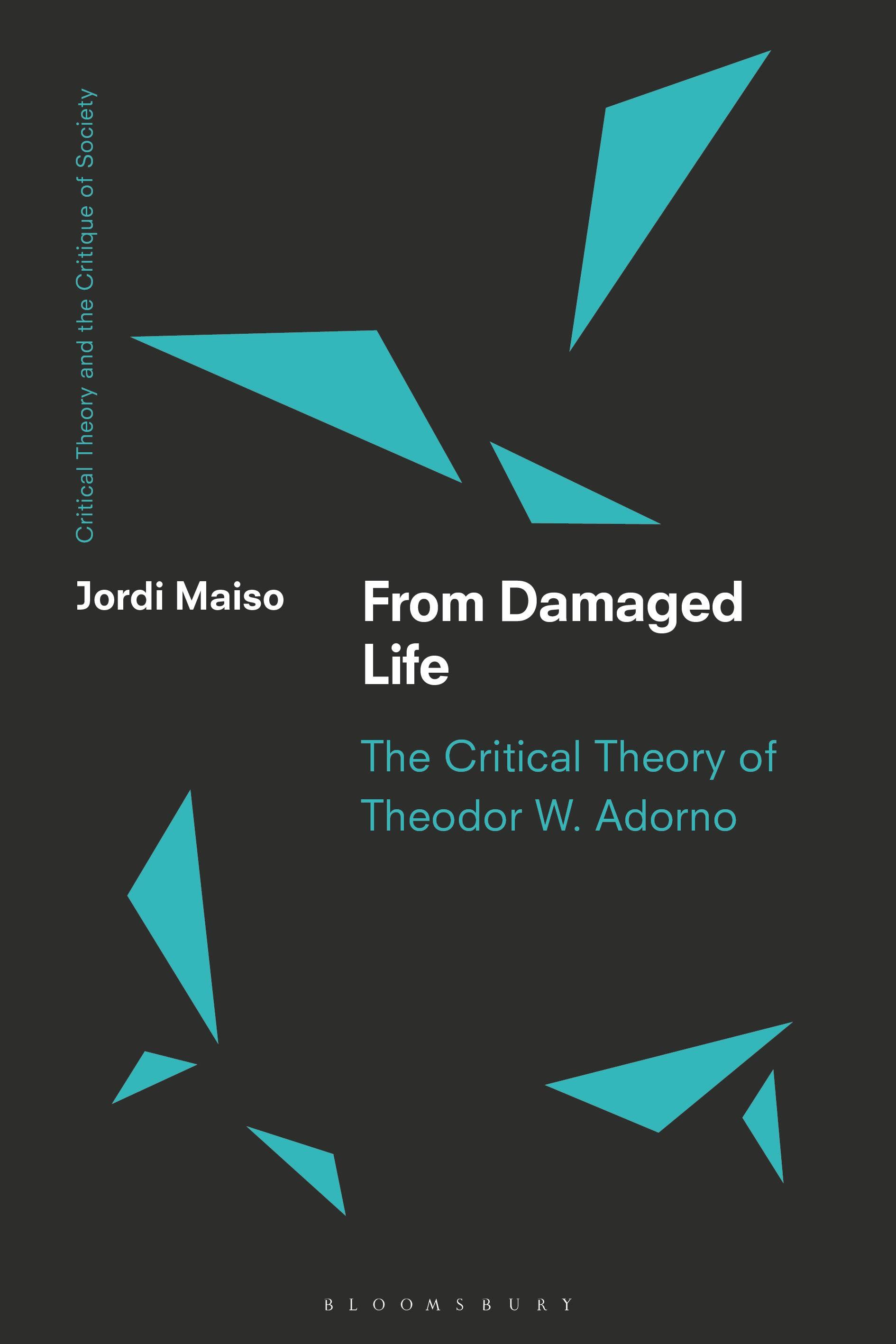
'Life does not live.'
This certainty – that the conditions governing existence in contemporary societies generate irretrievably damaged lives – lies at the heart of Theodor W. Adorno's critical theory. Emerging from the historical experience of fascism, Auschwitz, and the consolidation of advanced capitalism, Adorno's thought articulates critique from within a damaged reality.
Under the coercion of overwhelming social powers, individual character is constituted as a “system of scars”. This notion of “damaged life” stands at the center of this book, which frames critique as emerging from a reality scarred by systemic coercion. It reconstructs Adorno's critical theory as an analysis of the new state of unfreedom linked to total socialization, the anthropological reshaping of subjectivity under advanced capitalism, and the very possibility of critique.
Jordi Maiso's analysis spans key themes: the constellation of fascism and advanced capitalism, the culture industry's role in shaping consciousness, and the persistence of authoritarian potential in everyday life. Revisiting Adorno's conception of critique as a “science of mourning” and his insistence on determinate negation, the book shows how critical thought confronts a historical moment in which emancipatory horizons appear blocked yet remain necessary.
Both historical and urgent, From Damaged Life: The Critical Theory of Theodor W. Adorno interrogates the persistence of fear, heteronomy, and avoidable suffering. It asks whether, under conditions marked by authoritarian regression and damaged subjectivity, critical theory can still resist resignation and keep the possibility of transformation alive.
This certainty – that the conditions governing existence in contemporary societies generate irretrievably damaged lives – lies at the heart of Theodor W. Adorno's critical theory. Emerging from the historical experience of fascism, Auschwitz, and the consolidation of advanced capitalism, Adorno's thought articulates critique from within a damaged reality.
Under the coercion of overwhelming social powers, individual character is constituted as a “system of scars”. This notion of “damaged life” stands at the center of this book, which frames critique as emerging from a reality scarred by systemic coercion. It reconstructs Adorno's critical theory as an analysis of the new state of unfreedom linked to total socialization, the anthropological reshaping of subjectivity under advanced capitalism, and the very possibility of critique.
Jordi Maiso's analysis spans key themes: the constellation of fascism and advanced capitalism, the culture industry's role in shaping consciousness, and the persistence of authoritarian potential in everyday life. Revisiting Adorno's conception of critique as a “science of mourning” and his insistence on determinate negation, the book shows how critical thought confronts a historical moment in which emancipatory horizons appear blocked yet remain necessary.
Both historical and urgent, From Damaged Life: The Critical Theory of Theodor W. Adorno interrogates the persistence of fear, heteronomy, and avoidable suffering. It asks whether, under conditions marked by authoritarian regression and damaged subjectivity, critical theory can still resist resignation and keep the possibility of transformation alive.
Betal nemt med kort, Klarna, Apple Pay eller Google Pay. Ikke tilfreds? Du har altid 14 dages fortrydelsesret. Læs mere i vores vilkår. Har du spørgsmål, så send os en mail på hello@memmo.org.
Memmo gør det nemmere at studere – uanset hvor du er i verden. Hos os samler du dine kursusbøger og smarte studieværktøjer ét sted: resuméer, quizzer, podcasts og flashcards. Og så er der Ted, din studieven, der svarer på alt, du undrer dig over. Over 50 000 studerende studerer allerede her – bygget til at hjælpe dig med at lære hurtigere og stresse mindre.