
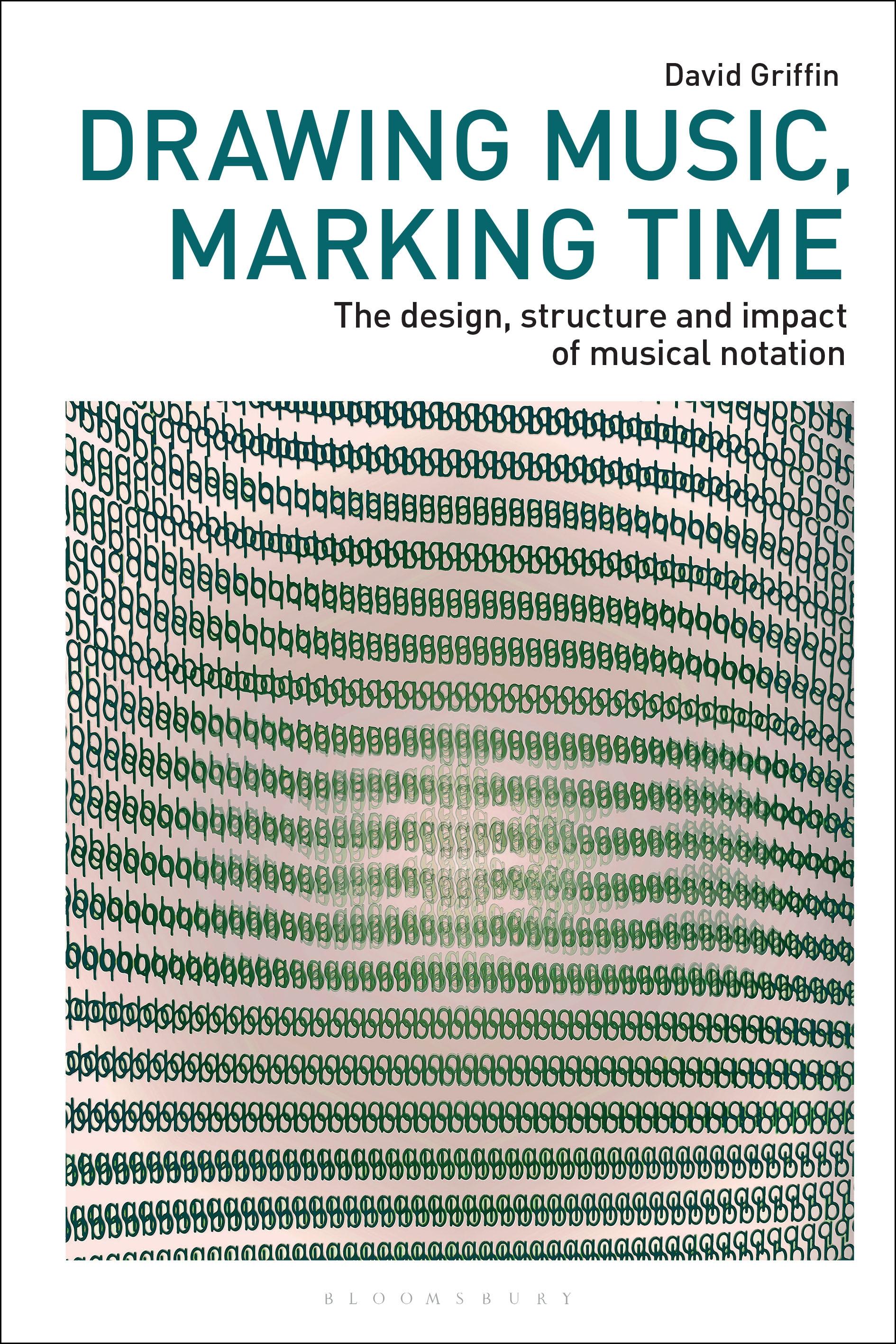
Marking down the complexities of musical pieces on paper allows them to become portable, shareable, and eminently teachable, but how are the simple geometries of a music notation unfolded into space and time?
A music notation is an almost impossibly complicated bit of drawing. Calling it a map or a diagram does not quite do the trick. Its tracery supplies mechanisms for planning, composition, analysis, annotation, and performance of music. But how is it that we read that simple, strategic two-dimensional geometry and make such complex, four-dimensional performances? In this book David Griffin guides readers to a comprehensive understanding of the structural properties of music notations, with a particular focus on the standard Western staff notation system, looking at composers such as Bach, John Cage, Earle Brown and Stockhausen.
Developed over a thousand years ago, the staff notation is a geometrical drawing method using dots and lines on a horizontal timeline for explaining the structure of a musical piece. The system behaves a bit like a picture, but it is also like a diagram, and a bit like writing in its structure. In the hands of an experienced user, the notation's complex of marks and phatic elements allows us to leave behind the mere denotation of diagrams or pictures to become a connotative drawing system.
This book will attempt to de-code music drawings, untangling their strange knots of graphic and linguistic elements. Using a series of visual examples, Griffin presents background information on how the staff notation developed as an inter-linguistic inscription, a drawing that slips through the mere denotation of pictorial or diagrammatic graphics to become a connotative system, with which we may craft subtle and powerful elements of musical poetry.
A music notation is an almost impossibly complicated bit of drawing. Calling it a map or a diagram does not quite do the trick. Its tracery supplies mechanisms for planning, composition, analysis, annotation, and performance of music. But how is it that we read that simple, strategic two-dimensional geometry and make such complex, four-dimensional performances? In this book David Griffin guides readers to a comprehensive understanding of the structural properties of music notations, with a particular focus on the standard Western staff notation system, looking at composers such as Bach, John Cage, Earle Brown and Stockhausen.
Developed over a thousand years ago, the staff notation is a geometrical drawing method using dots and lines on a horizontal timeline for explaining the structure of a musical piece. The system behaves a bit like a picture, but it is also like a diagram, and a bit like writing in its structure. In the hands of an experienced user, the notation's complex of marks and phatic elements allows us to leave behind the mere denotation of diagrams or pictures to become a connotative drawing system.
This book will attempt to de-code music drawings, untangling their strange knots of graphic and linguistic elements. Using a series of visual examples, Griffin presents background information on how the staff notation developed as an inter-linguistic inscription, a drawing that slips through the mere denotation of pictorial or diagrammatic graphics to become a connotative system, with which we may craft subtle and powerful elements of musical poetry.
Betal nemt med kort, Klarna, Apple Pay eller Google Pay. Ikke tilfreds? Du har altid 14 dages fortrydelsesret. Læs mere i vores vilkår. Har du spørgsmål, så send os en mail på hello@memmo.org.
Memmo gør det nemmere at studere – uanset hvor du er i verden. Hos os samler du dine kursusbøger og smarte studieværktøjer ét sted: resuméer, quizzer, podcasts og flashcards. Og så er der Ted, din studieven, der svarer på alt, du undrer dig over. Over 50 000 studerende studerer allerede her – bygget til at hjælpe dig med at lære hurtigere og stresse mindre.