
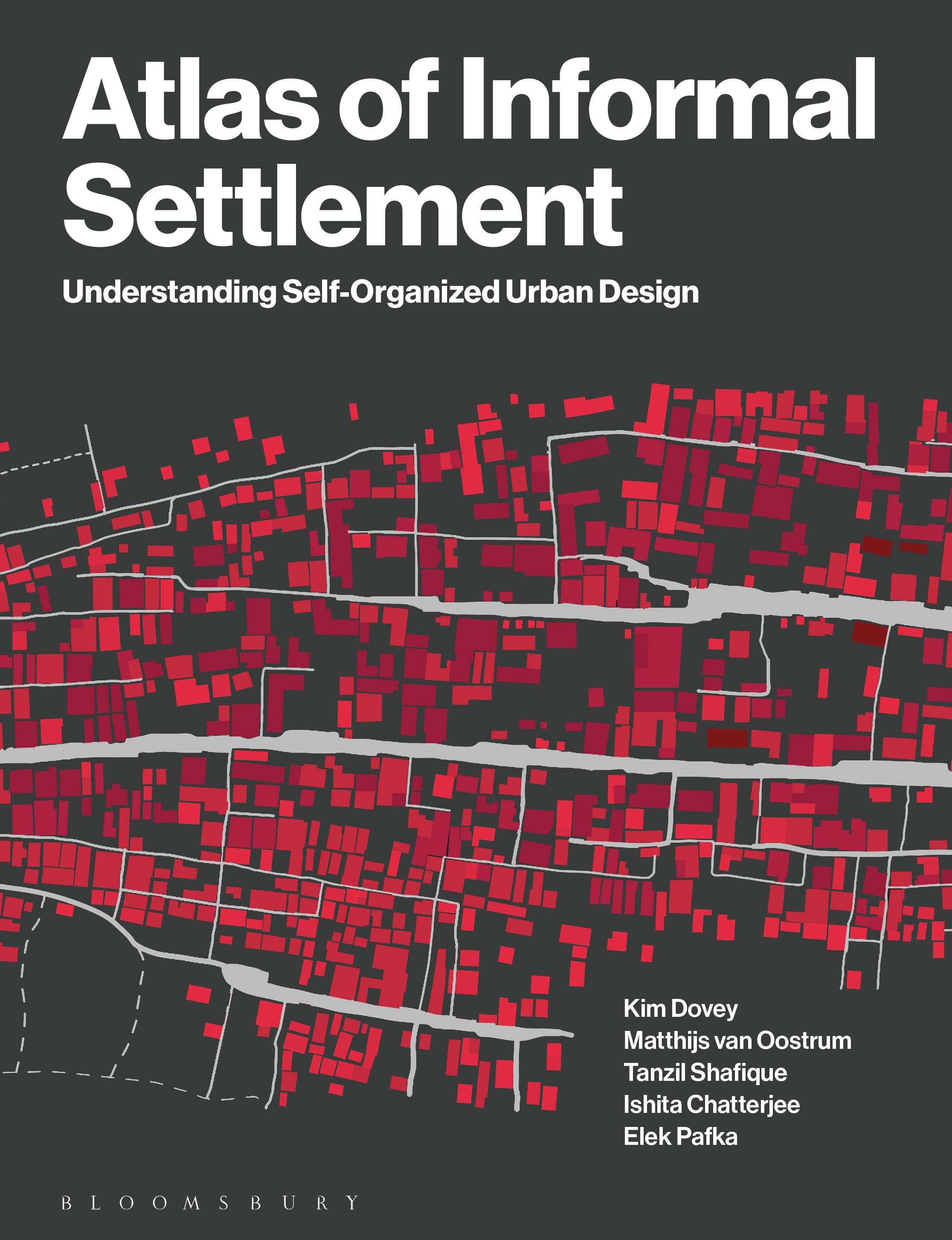
While often seen as unplanned or spontaneous, informal settlement is better understood as a mode of production: a co-evolution of architecture, urban design and planning that embodies informal rules and shapes urban development.
The Atlas of Informal Settlement is a comparative study of the spatial logic of informal settlement based on mapping and analysing the evolution of urban form (morphogenesis) in 51 contemporary settlements across the planet – the first of its kind and a fundamental change in thinking for urban studies and built environment professionals.
Each of the 51 case studies uses maps and aerial photographs to examine key stages of development, showing how informal settlement adapts to different contexts of political economy, topography, culture, climate and land tenure; revealing a complex range of actors from settlers and states to land mafias and pirate developers. It demonstrates the range of design processes and formal outcomes; how the informal becomes formalized and vice versa. Interspersed with short chapters introducing key theoretical concepts, the Atlas shows how such practices may or may not produce 'slums', and how settlement is already a form of 'upgrading'.
Informal settlement is the primary mode of production of affordable housing and neighbourhood infrastructure within cities of the Global South; with detailed mapping and profiling of 51 settlements this book shows how such urban morphologies emerge in terms of architecture, urban design and planning.
The Atlas of Informal Settlement is a comparative study of the spatial logic of informal settlement based on mapping and analysing the evolution of urban form (morphogenesis) in 51 contemporary settlements across the planet – the first of its kind and a fundamental change in thinking for urban studies and built environment professionals.
Each of the 51 case studies uses maps and aerial photographs to examine key stages of development, showing how informal settlement adapts to different contexts of political economy, topography, culture, climate and land tenure; revealing a complex range of actors from settlers and states to land mafias and pirate developers. It demonstrates the range of design processes and formal outcomes; how the informal becomes formalized and vice versa. Interspersed with short chapters introducing key theoretical concepts, the Atlas shows how such practices may or may not produce 'slums', and how settlement is already a form of 'upgrading'.
Informal settlement is the primary mode of production of affordable housing and neighbourhood infrastructure within cities of the Global South; with detailed mapping and profiling of 51 settlements this book shows how such urban morphologies emerge in terms of architecture, urban design and planning.
Sider: 304
Kategori: Arkitektur & Stadsplanering
e-ISBN: 9781350295063
Forsendelsesvægt: 1.2 kg
Sendes inden for: 1-2 dage
Betal nemt med kort, Klarna, Apple Pay eller Google Pay. Ikke tilfreds? Du har altid 14 dages fortrydelsesret. Læs mere i vores vilkår. Har du spørgsmål, så send os en mail på hello@memmo.org.
Memmo gør det nemmere at studere – uanset hvor du er i verden. Hos os samler du dine kursusbøger og smarte studieværktøjer ét sted: resuméer, quizzer, podcasts og flashcards. Og så er der Ted, din studieven, der svarer på alt, du undrer dig over. Over 50 000 studerende studerer allerede her – bygget til at hjælpe dig med at lære hurtigere og stresse mindre.