
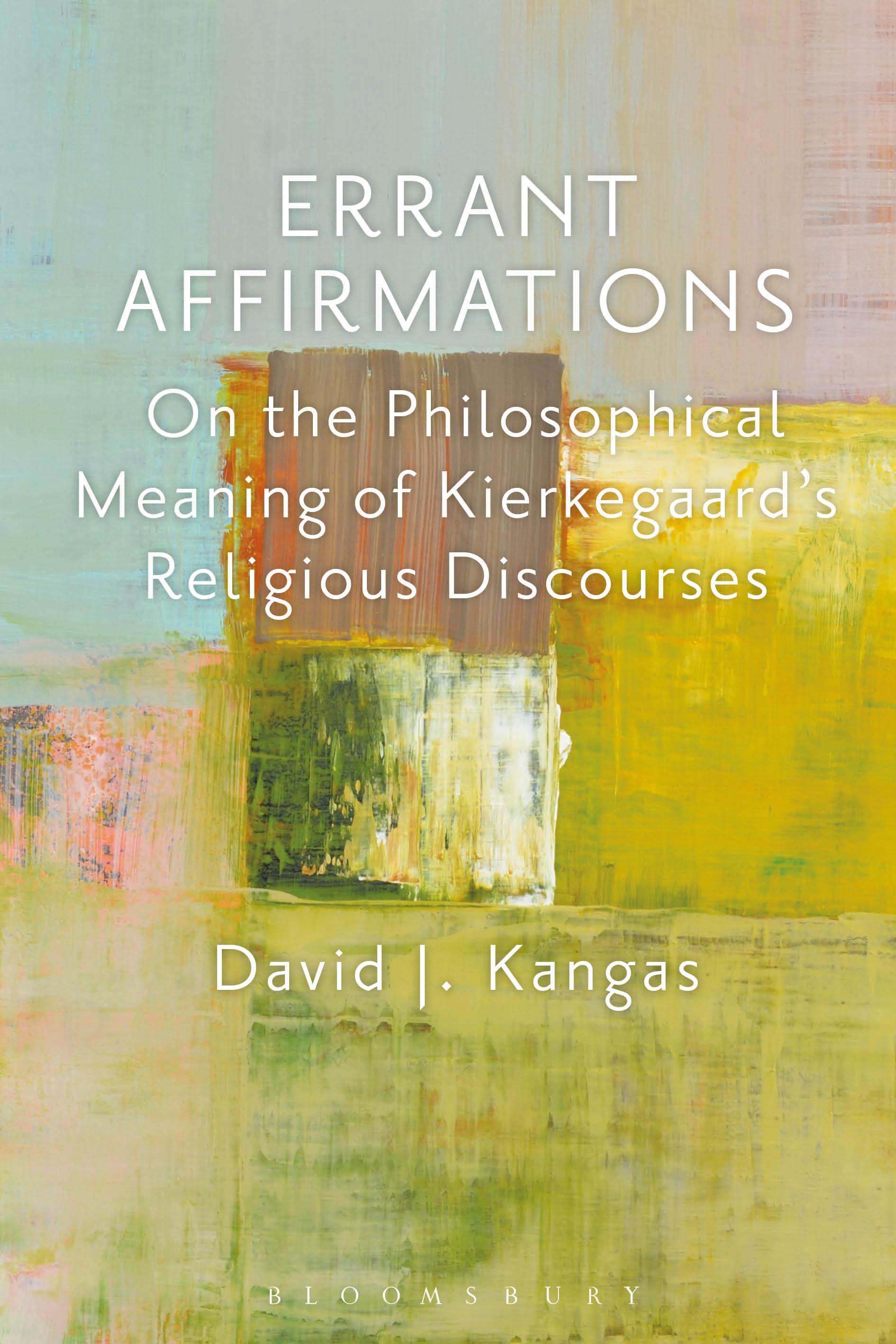
Kierkegaard's religious discourses - his writings which have explicitly dealt with religion - have historically been given scant attention by philosophers. They have generally been considered to be of less philosophical interest than his 'proper' philosophy. Errant Affirmations radically questions this claim and considers Kierkegaard's religious writings as absolutely central to his philosophical vision.
Through close and clear readings of Kierkegaard's work, David Kangas argues that contemporary philosophical themes - gift, temporality, language, death, nothingness, economy and selfhood- are not only evident in the 'religious' works but explored with real depth and fascination. Above all, the book argues that Kierkegaard's positive account of the human condition, his “ontology,” fully emerges only in these discourses. It shows how these discourses are organized around an “errant” kind of affirmation-namely, an affirmation of existence that is without conditions. Such affirmation involves the intensification of life around “today” and coincides with a joy that has no particular cause. It is an affirmation capable of affirming life even amidst its finitude and suffering.
Errant Affirmations is a fresh interpretation of Kierkegaard's understudied works that not only opens up a new reading of Kierkegaard but elucidates his 'religious' texts and places them organically within his philosophy as a whole.
Through close and clear readings of Kierkegaard's work, David Kangas argues that contemporary philosophical themes - gift, temporality, language, death, nothingness, economy and selfhood- are not only evident in the 'religious' works but explored with real depth and fascination. Above all, the book argues that Kierkegaard's positive account of the human condition, his “ontology,” fully emerges only in these discourses. It shows how these discourses are organized around an “errant” kind of affirmation-namely, an affirmation of existence that is without conditions. Such affirmation involves the intensification of life around “today” and coincides with a joy that has no particular cause. It is an affirmation capable of affirming life even amidst its finitude and suffering.
Errant Affirmations is a fresh interpretation of Kierkegaard's understudied works that not only opens up a new reading of Kierkegaard but elucidates his 'religious' texts and places them organically within his philosophy as a whole.
Betal nemt med kort, Klarna, Apple Pay eller Google Pay. Ikke tilfreds? Du har altid 14 dages fortrydelsesret. Læs mere i vores vilkår. Har du spørgsmål, så send os en mail på hello@memmo.org.
Memmo gør det nemmere at studere – uanset hvor du er i verden. Hos os samler du dine kursusbøger og smarte studieværktøjer ét sted: resuméer, quizzer, podcasts og flashcards. Og så er der Ted, din studieven, der svarer på alt, du undrer dig over. Over 50 000 studerende studerer allerede her – bygget til at hjælpe dig med at lære hurtigere og stresse mindre.