
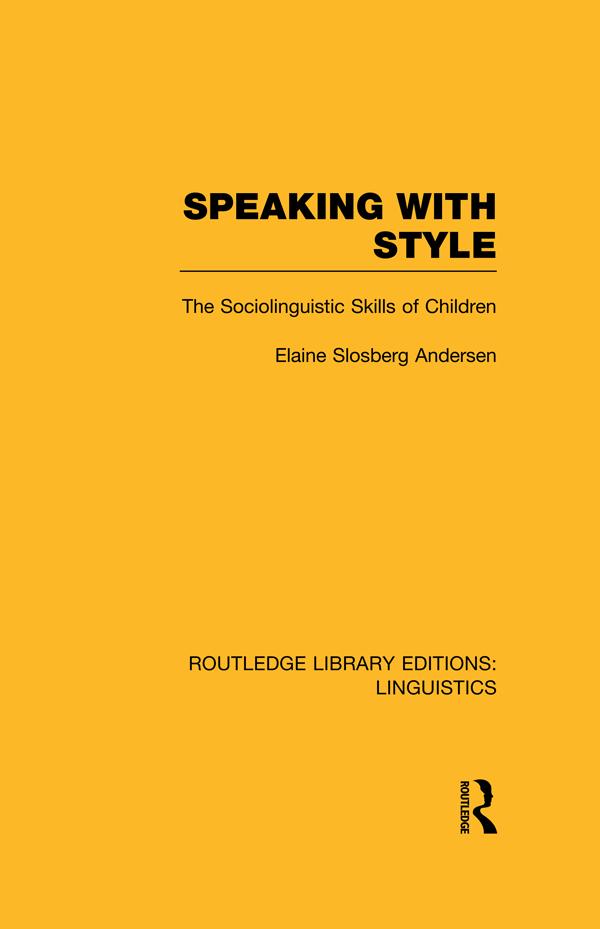
In acquiring communicative competence, children must learn to speak not only grammatically but also appropriately. Although rules for appropriate language use may vary from culture to culture, they are usually sensitive across languages to many of the same factors, including the context and the topic of the discourse, and the sex, age, familiarity and relative status of the speaker and the listener. There is available detailed evidence of the ways in which adults consistently modify their speech to foreigners, of phonological, syntactic, and lexical markings of language in professional settings, and of differences in men’s and women’s speech that are tied to their roles in society.
This book examines young children’s knowledge of the sociolinguistic rules that govern appropriate language use, exploring (i) the repertoire of registers (ie speech varieties) that young children possess; (ii) the linguistic devices that they use to mark distinct registers; (iii) the way their skill in using these registers develops.
Betal nemt med kort, Klarna, Apple Pay eller Google Pay. Ikke tilfreds? Du har altid 14 dages fortrydelsesret. Læs mere i vores vilkår. Har du spørgsmål, så send os en mail på hello@memmo.org.
Memmo gør det nemmere at studere – uanset hvor du er i verden. Hos os samler du dine kursusbøger og smarte studieværktøjer ét sted: resuméer, quizzer, podcasts og flashcards. Og så er der Ted, din studieven, der svarer på alt, du undrer dig over. Over 50 000 studerende studerer allerede her – bygget til at hjælpe dig med at lære hurtigere og stresse mindre.