
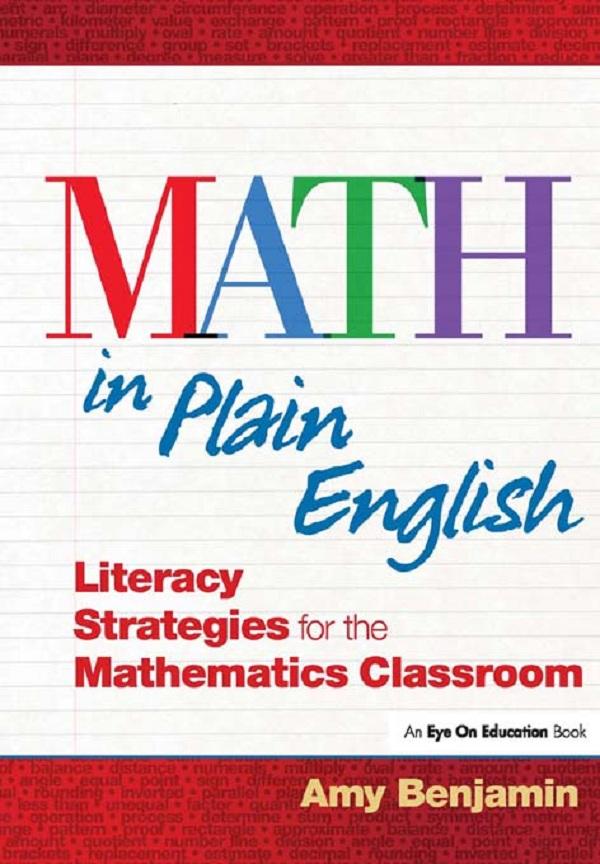
Do word problems and math vocabulary confuse students in your mathematics classes? Do simple keywords like "value" and "portion" seem to mislead them?
Many words that students already know can have a different meaning in mathematics. To grasp that difference, students need to connect English literacy skills to math. Successful students speak, read, write, and listen to each other so they can understand, retain, and apply mathematics concepts.
This book explains how to use 10 classroom-ready literacy strategies in concert with your mathematics instruction. You’ll learn how to develop students who are able to explain to themselves - and communicate to others - what problems mean and how to attack them.
Embedding these strategies in your instruction will help your students gain the literacy skills required to achieve the eight Common Core State Standards for Mathematics. You’ll discover the best answer to their question, "When am I ever going to use this?"
The 10 Strategies:
1. Teaching mathematical words explicitly
2. Teaching academic words implicitly
3. Reinforcing reading comprehension skills that apply to mathematics
4. Teaching mathematics with metaphor and gesture
5. Unlocking the meaning of word problems
6. Teaching note-taking skills for mathematics
7. Using language-based formative assessment in mathematics
8. Connecting memorization to meaning in mathematics
9. Incorporating writing-to-learn activities in mathematics
10. Preparing students for algebraic thinking
Betal nemt med kort, Klarna, Apple Pay eller Google Pay. Ikke tilfreds? Du har altid 14 dages fortrydelsesret. Læs mere i vores vilkår. Har du spørgsmål, så send os en mail på hello@memmo.org.
Memmo gør det nemmere at studere – uanset hvor du er i verden. Hos os samler du dine kursusbøger og smarte studieværktøjer ét sted: resuméer, quizzer, podcasts og flashcards. Og så er der Ted, din studieven, der svarer på alt, du undrer dig over. Over 50 000 studerende studerer allerede her – bygget til at hjælpe dig med at lære hurtigere og stresse mindre.