
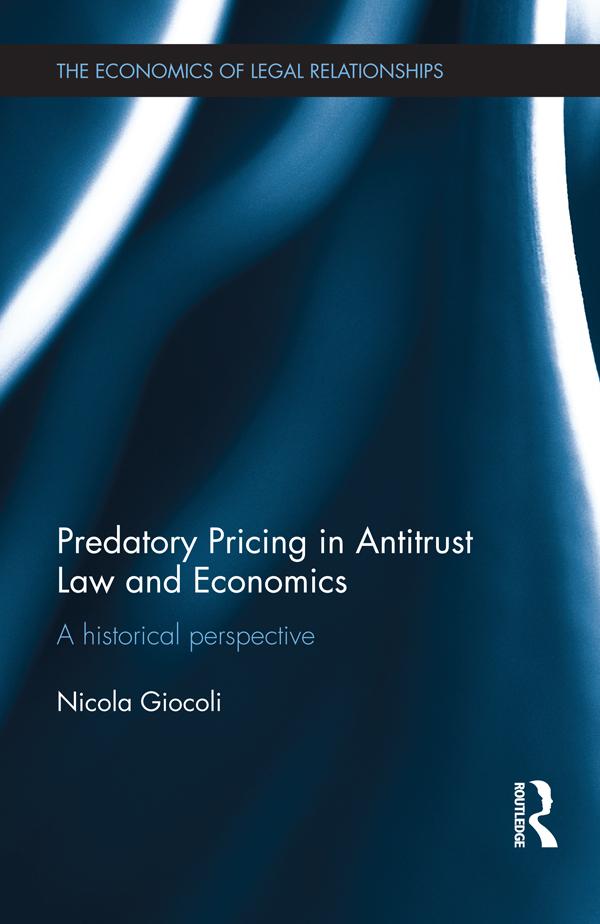
Can a price ever be too low? Can competition ever be ruinous? Questions like these have always accompanied American antitrust law. They testify to the difficulty of antitrust enforcement, of protecting competition without protecting competitors.
As the business practice that most directly raises these kinds of questions, predatory pricing is at the core of antitrust debates. The history of its law and economics offers a privileged standpoint for assessing the broader development of antitrust, its past, present and future. In contrast to existing literature, this book adopts the perspective of the history of economic thought to tell this history, covering a period from the late 1880s to present times.
The image of a big firm, such as Rockefeller’s Standard Oil or Duke’s American Tobacco, crushing its small rivals by underselling them is iconic in American antitrust culture. It is no surprise that the most brilliant legal and economic minds of the last 130 years have been engaged in solving the predatory pricing puzzle. The book shows economic theories that build rigorous stories explaining when predatory pricing may be rational, what welfare harm it may cause and how the law may fight it. Among these narratives, a special place belongs to the Chicago story, according to which predatory pricing is never profitable and every low price is always a good price.
Betal nemt med kort, Klarna, Apple Pay eller Google Pay. Ikke tilfreds? Du har altid 14 dages fortrydelsesret. Læs mere i vores vilkår. Har du spørgsmål, så send os en mail på hello@memmo.org.
Memmo gør det nemmere at studere – uanset hvor du er i verden. Hos os samler du dine kursusbøger og smarte studieværktøjer ét sted: resuméer, quizzer, podcasts og flashcards. Og så er der Ted, din studieven, der svarer på alt, du undrer dig over. Over 50 000 studerende studerer allerede her – bygget til at hjælpe dig med at lære hurtigere og stresse mindre.