
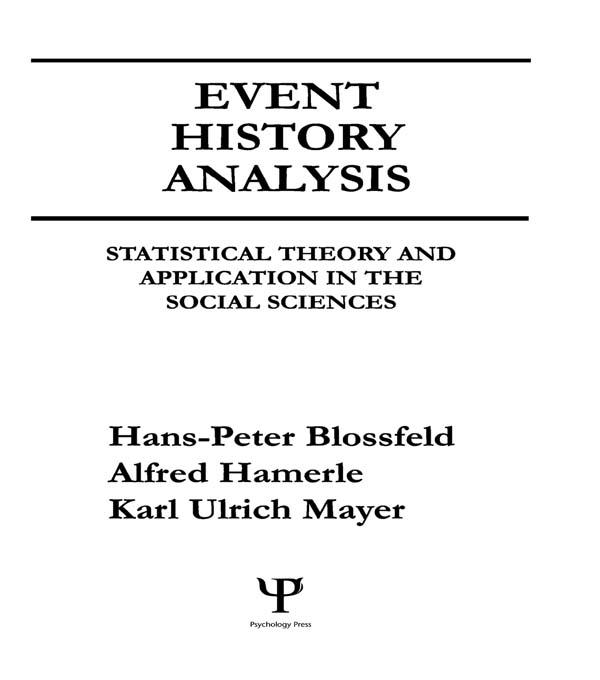
Serving as both a student textbook and a professional reference/handbook, this volume explores the statistical methods of examining time intervals between successive state transitions or events. Examples include: survival rates of patients in medical studies, unemployment periods in economic studies, or the period of time it takes a criminal to break the law after his release in a criminological study. The authors illustrate the entire research path required in the application of event-history analysis, from the initial problems of recording event-oriented data to the specific questions of data organization, to the concrete application of available program packages and the interpretation of the obtained results.
Event History Analysis:
* makes didactically accessible the inclusion of covariates in semi-parametric and parametric regression models based upon concrete examples
* presents the unabbreviated close relationship underlying statistical theory
* details parameter-free methods of analysis of event-history data and the possibilities of their graphical presentation
* discusses specific problems of multi-state and multi-episode models
* introduces time-varying covariates and the question of unobserved population heterogeneity
* demonstrates, through examples, how to implement hypotheses tests and how to choose the right model.
Betal nemt med kort, Klarna, Apple Pay eller Google Pay. Ikke tilfreds? Du har altid 14 dages fortrydelsesret. Læs mere i vores vilkår. Har du spørgsmål, så send os en mail på hello@memmo.org.
Memmo gør det nemmere at studere – uanset hvor du er i verden. Hos os samler du dine kursusbøger og smarte studieværktøjer ét sted: resuméer, quizzer, podcasts og flashcards. Og så er der Ted, din studieven, der svarer på alt, du undrer dig over. Over 50 000 studerende studerer allerede her – bygget til at hjælpe dig med at lære hurtigere og stresse mindre.