
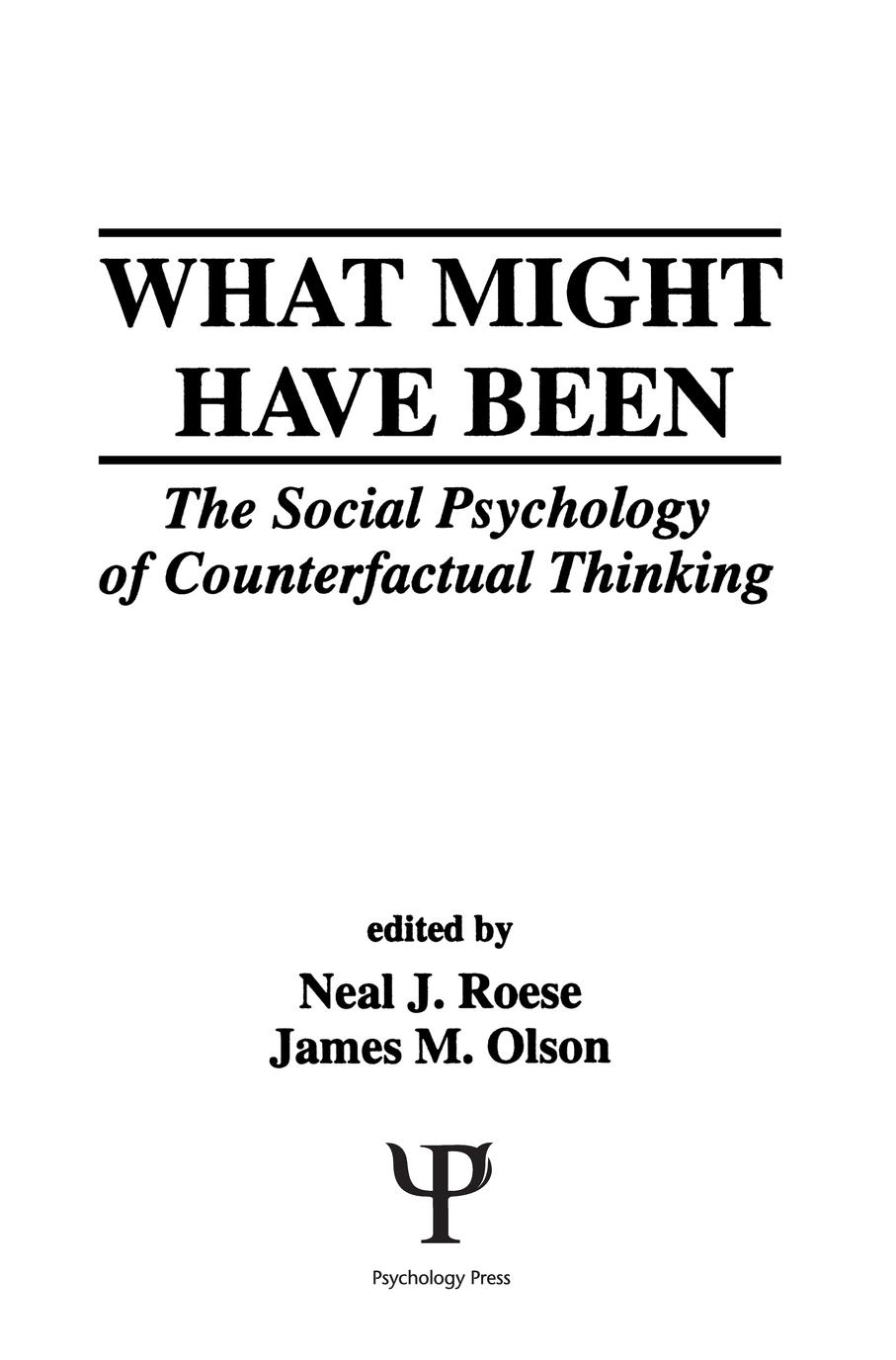
Within a few short years, research on counterfactual thinking has mushroomed, establishing itself as one of the signature domains within social psychology. Counterfactuals are thoughts of what might have been, of possible past outcomes that could have taken place. Counterfactuals and their implications for perceptions of time and causality have long fascinated philosophers, but only recently have social psychologists made them the focus of empirical inquiry.
Following the publication of Kahneman and Tversky's seminal 1982 paper, a burgeoning literature has implicated counterfactual thinking in such diverse judgments as causation, blame, prediction, and suspicion; in such emotional experiences as regret, elation, disappointment and sympathy; and also in achievement, coping, and intergroup bias. But how do such thoughts come about? What are the mechanisms underlying their operation? How do their consequences benefit, or harm, the individual? When is their generation spontaneous and when is it strategic? This volume explores these and other numerous issues by assembling contributions from the most active researchers in this rapidly expanding subfield of social psychology. Each chapter provides an in-depth exploration of a particular conceptual facet of counterfactual thinking, reviewing previous work, describing ongoing, cutting-edge research, and offering novel theoretical analysis and synthesis. As the first edited volume to bring together the many threads of research and theory on counterfactual thinking, this book promises to be a source of insight and inspiration for years to come.
Betal nemt med kort, Klarna, Apple Pay eller Google Pay. Ikke tilfreds? Du har altid 14 dages fortrydelsesret. Læs mere i vores vilkår. Har du spørgsmål, så send os en mail på hello@memmo.org.
Memmo gør det nemmere at studere – uanset hvor du er i verden. Hos os samler du dine kursusbøger og smarte studieværktøjer ét sted: resuméer, quizzer, podcasts og flashcards. Og så er der Ted, din studieven, der svarer på alt, du undrer dig over. Over 50 000 studerende studerer allerede her – bygget til at hjælpe dig med at lære hurtigere og stresse mindre.