
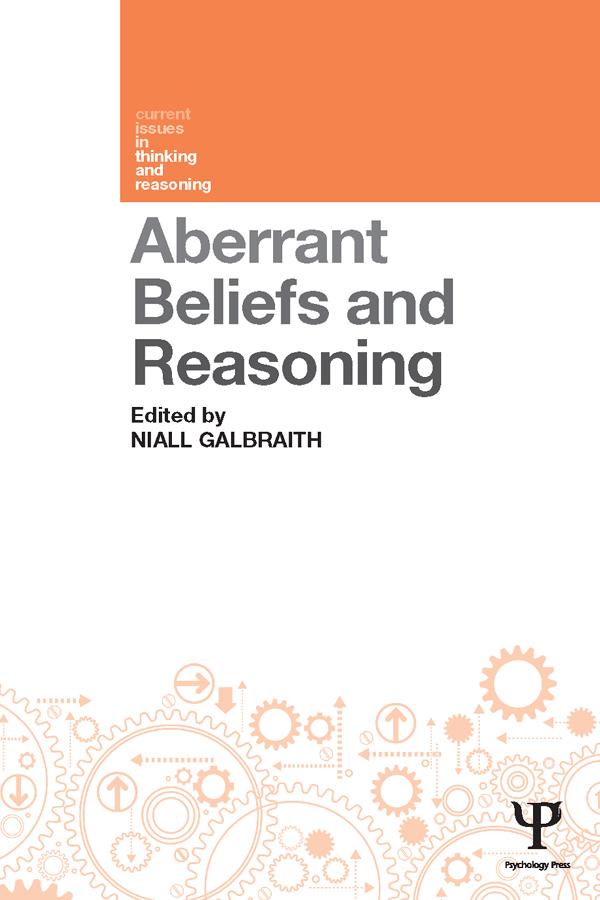
An aberrant belief is extreme or unusual in nature. In the most serious cases these beliefs cause emotional distress in those who hold them, and typify the core symptoms of psychological disorders. Each of the chapters in this volume seeks to examine the role that biases in reasoning can play in the formation of aberrant beliefs.
The chapters consider several conjectures about the role of reasoning in aberrant belief, including the role of the jumping to conclusion bias in delusional beliefs, the probabilistic bias in paranormal beliefs, the role of danger confirming reasoning in phobias, and the controversial notion that people with schizophrenia do not succumb to specific forms of reasoning bias. There are also chapters evaluating different theoretical perspectives, and suggestions for future research.
Aberrant Beliefs and Reasoning is the first volume presenting an overview of contemporary research in this growing subject area. It will be essential reading for academics and students in the fields of human reasoning, cognitive psychology and philosophy, and will also be of great interest to clinicians and psychiatrists.
Betal nemt med kort, Klarna, Apple Pay eller Google Pay. Ikke tilfreds? Du har altid 14 dages fortrydelsesret. Læs mere i vores vilkår. Har du spørgsmål, så send os en mail på hello@memmo.org.
Memmo gør det nemmere at studere – uanset hvor du er i verden. Hos os samler du dine kursusbøger og smarte studieværktøjer ét sted: resuméer, quizzer, podcasts og flashcards. Og så er der Ted, din studieven, der svarer på alt, du undrer dig over. Over 50 000 studerende studerer allerede her – bygget til at hjælpe dig med at lære hurtigere og stresse mindre.