
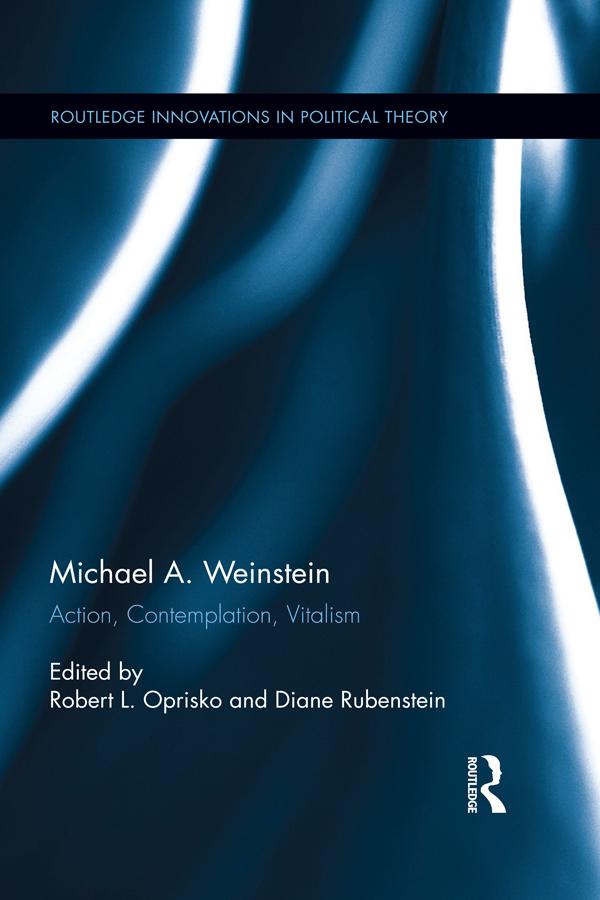
This book is a major reassessment of Michael Weinstein’s political philosophy. It situates his singular contribution, designated as "critical vitalism," in the context of both canonical American and contemporary continental theory. Weinstein is presented as a philosopher of life and as an American Nietzsche. Yet the contributors also persuasively argue for this form of thinking as a prescient prophecy addressing contemporary society’s concern over the management of life as well as the technological changes that both threaten and sustain intimacy. This is the first full scale study of Weinstein’s work which reveals surprising aspects of a philosophic journey that has encompassed most of the major American (pragmatic or vitalist) or Continental (phenomenological or existential) traditions. Weinstein is read as a comparative political theorist, a precursor to post-structuralism, and as a post-colonial border theorist. A different aspect of his oeuvre is highlighted in each of the book’s three sections. The opening essays comprising the "Action" diptych contrasts meditative versus extrapolative approaches; "Contemplation" stages a series of encounters between Weinstein and his philosophic interlocutors; "Vitalism" presents Weinstein as a teacher, media analyst, musician, and performance artist. The book contains an epilogue written by Weinstein in response to the contributors.
Betal nemt med kort, Klarna, Apple Pay eller Google Pay. Ikke tilfreds? Du har altid 14 dages fortrydelsesret. Læs mere i vores vilkår. Har du spørgsmål, så send os en mail på hello@memmo.org.
Memmo gør det nemmere at studere – uanset hvor du er i verden. Hos os samler du dine kursusbøger og smarte studieværktøjer ét sted: resuméer, quizzer, podcasts og flashcards. Og så er der Ted, din studieven, der svarer på alt, du undrer dig over. Over 50 000 studerende studerer allerede her – bygget til at hjælpe dig med at lære hurtigere og stresse mindre.