
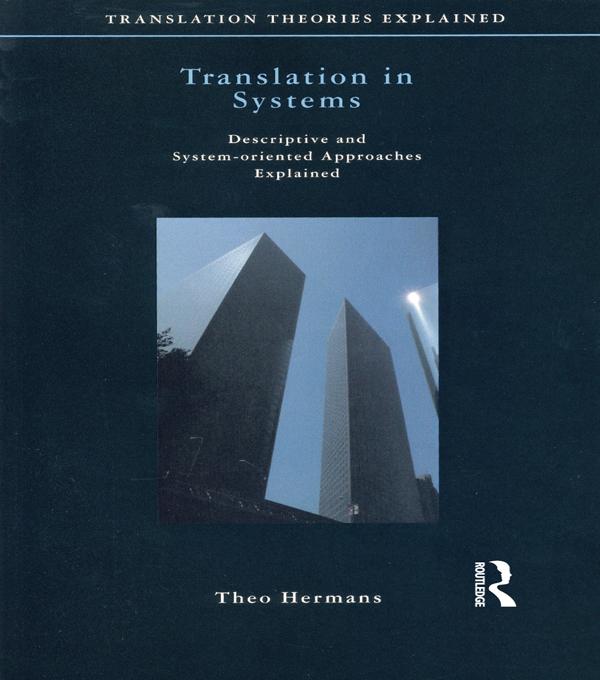
The notion of systems has helped revolutionize translation studies since the 1970s. As a key part of many descriptive approaches, it has broken with the prescriptive focus on what translation should be, encouraging researchers to ask what translation does in specific cultural settings. From his privileged position as a direct participant in these developments, Theo Hermans explains how contemporary descriptive approaches came about, what the basic ideas were, and how those ideas have evolved over time. His discussion addresses the fundamental problems of translation norms, equivalence, polysystems and social systems, covering not only the work of Levý, Holmes, Even-Zohar, Toury, Lefevere, Lambert, Van Leuven-Zwart, Dhulst and others, but also giving special attention to recent contributions derived from Pierre Bourdieu and Niklas Luhmann. An added focus on practical questions of how to investigate translation (problems of definition, description, assessment of readerships, etc.) makes this book essential reading for graduate students and indeed any researchers in the field. Hermans' account of descriptive translation studies is both informed and critical. At the same time, he demonstrates the strength of the basic concepts, which have shown considerable vitality in their evolution and adaptation to the debates of the present day.
Betal nemt med kort, Klarna, Apple Pay eller Google Pay. Ikke tilfreds? Du har altid 14 dages fortrydelsesret. Læs mere i vores vilkår. Har du spørgsmål, så send os en mail på hello@memmo.org.
Memmo gør det nemmere at studere – uanset hvor du er i verden. Hos os samler du dine kursusbøger og smarte studieværktøjer ét sted: resuméer, quizzer, podcasts og flashcards. Og så er der Ted, din studieven, der svarer på alt, du undrer dig over. Over 50 000 studerende studerer allerede her – bygget til at hjælpe dig med at lære hurtigere og stresse mindre.
Du kan måske også lide
Køb bogen0