
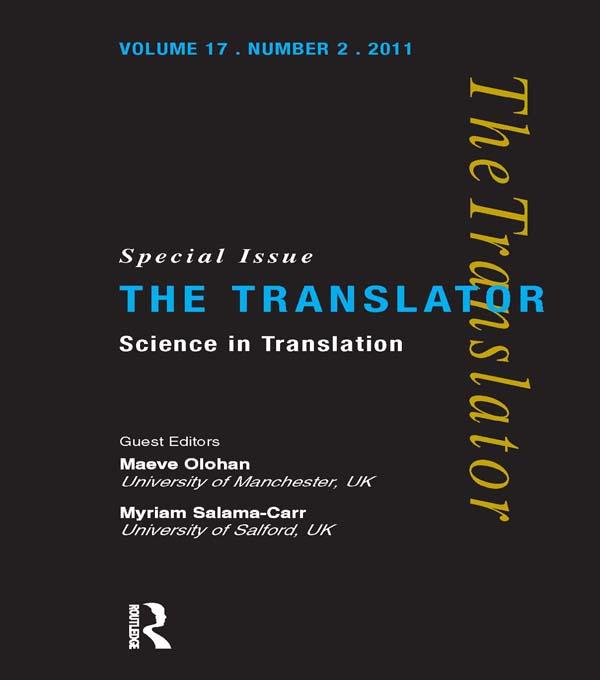
Despite the crucial role played by translation in the history of scientific ideas and the transmission of knowledge, historians of science have seldom been interested in the translation activity which enabled the spread of those ideas and exerted influence on structures and systems of knowledge. Translation scholars, too, have traditionally shown little interest in theorizing scientific translation. Recent conceptualizations of science as public culture, institution, narrative and rhetorical practice open the way for research on the translation of science to take conceptual and methodological inspiration from studies of discourse, rhetoric, the sociology of science, the history of science, the philosophy of science and other related fields.
This special issue of The Translator foregrounds the work of researchers, within or on the periphery of translation studies, who have begun to interrogate the representation of scientific knowledge through translation. Drawing on a wide range of disciplines and models, contributors engage with different perspectives and approaches to help promote the visibility of scientific translation and shed light on its complex relationship with power and the construction of knowledge.
Contributors: Brecht Algoet, Karen Bennett, Lidia Camara, Eva Espasa, Lieve Jooken, Monika Krein-Kühle, Min-Hsiu Liao, Ruselle Meade, Guy Rooryck, Dolores Sánchez, Hala Sharkas, Mark Shuttleworth, Richard Somerset, Liselotte Vandenbussche , Sonia Vandepitte
Betal nemt med kort, Klarna, Apple Pay eller Google Pay. Ikke tilfreds? Du har altid 14 dages fortrydelsesret. Læs mere i vores vilkår. Har du spørgsmål, så send os en mail på hello@memmo.org.
Memmo gør det nemmere at studere – uanset hvor du er i verden. Hos os samler du dine kursusbøger og smarte studieværktøjer ét sted: resuméer, quizzer, podcasts og flashcards. Og så er der Ted, din studieven, der svarer på alt, du undrer dig over. Over 50 000 studerende studerer allerede her – bygget til at hjælpe dig med at lære hurtigere og stresse mindre.