
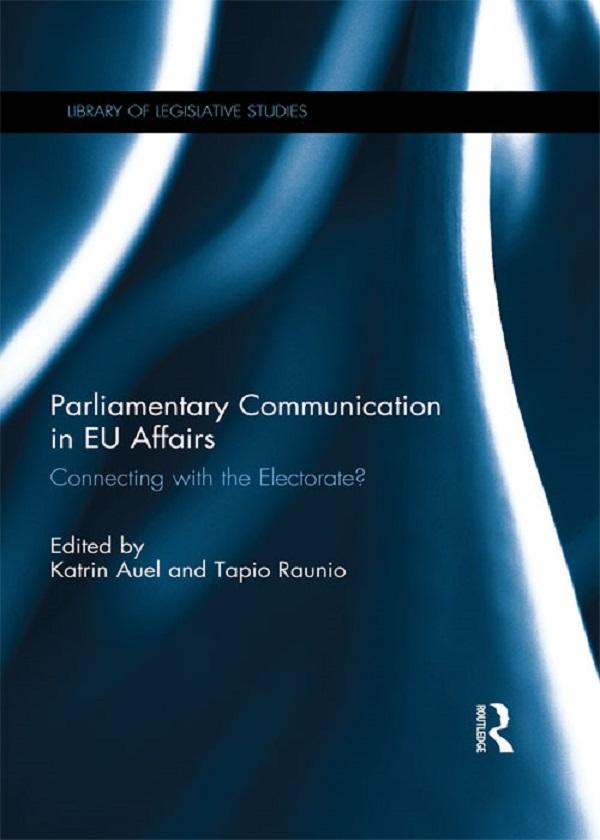
Over the last twenty years, the role of national parliaments in EU affairs has gained considerable academic attention. Much of the literature, however, has focused on parliamentary scrutiny and control in EU affairs. What tends to be generally overlooked is that the parliamentary communication function is at least as important in EU politics as the control function. Democratic legitimacy depends on a vibrant public debate on political solutions and alternatives to allow citizens to make informed political (electoral) choices and to exercise democratic control. Within the EU, it is precisely the opacity of policy-making processes and the lack of public discourse that have been defined as core problems of democratic legitimacy. Here, parliaments have the potential to provide an ideal arena for the deliberation of important European issues and thus to help overcome the much-lamented distance between European policy processes and the citizens. Yet, despite parliaments' central relevance for the legitimacy of European politics, the parliamentary communication function remains so far under researched. The volume aims at filling this gap by providing both qualitative and quantitative comparative data on various communication efforts by national parliaments.
This book was originally published as a special issue in the Journal of Legislative Studies.
Betal nemt med kort, Klarna, Apple Pay eller Google Pay. Ikke tilfreds? Du har altid 14 dages fortrydelsesret. Læs mere i vores vilkår. Har du spørgsmål, så send os en mail på hello@memmo.org.
Memmo gør det nemmere at studere – uanset hvor du er i verden. Hos os samler du dine kursusbøger og smarte studieværktøjer ét sted: resuméer, quizzer, podcasts og flashcards. Og så er der Ted, din studieven, der svarer på alt, du undrer dig over. Over 50 000 studerende studerer allerede her – bygget til at hjælpe dig med at lære hurtigere og stresse mindre.