
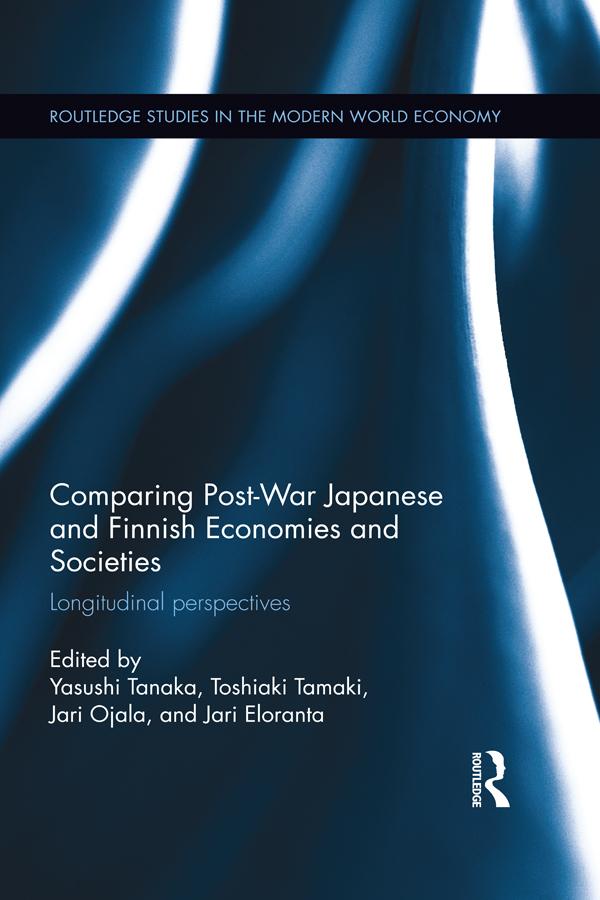
This book compares two countries with striking parallels in economic and political outcomes, yet with some distinct features in terms of institutional structures, relative size, and culture. Therefore, this book forms a fruitful platform for the study of the similarities and differences in the economic and societal development of Japan and Finland. Despite their geographic distance from one another and the aforementioned differences, both countries experienced rather similar economic and societal development patterns after the Second World War. The study of these societies both individually and through commonalities will provide a unique perspective on the emergence of modern economies and institutions.
The book provides comprehensive coverage on issues such as welfare state formation and society, security and military spending, education system, industrial development, international trade, governmental economic policies, energy solutions, and bubbles and their collapse; thus, issues typical for these countries, as well as most modern states, studied from a longitudinal perspective.
The book aims to answer a fundamental question in social science: Why do there seem to be common trends and developmental paths among countries differing in size, culture, and economic structure? This book will provide insights for those seeking to decipher how the developments in their own countries came about and where they may be headed to.
Betal nemt med kort, Klarna, Apple Pay eller Google Pay. Ikke tilfreds? Du har altid 14 dages fortrydelsesret. Læs mere i vores vilkår. Har du spørgsmål, så send os en mail på hello@memmo.org.
Memmo gør det nemmere at studere – uanset hvor du er i verden. Hos os samler du dine kursusbøger og smarte studieværktøjer ét sted: resuméer, quizzer, podcasts og flashcards. Og så er der Ted, din studieven, der svarer på alt, du undrer dig over. Over 50 000 studerende studerer allerede her – bygget til at hjælpe dig med at lære hurtigere og stresse mindre.