
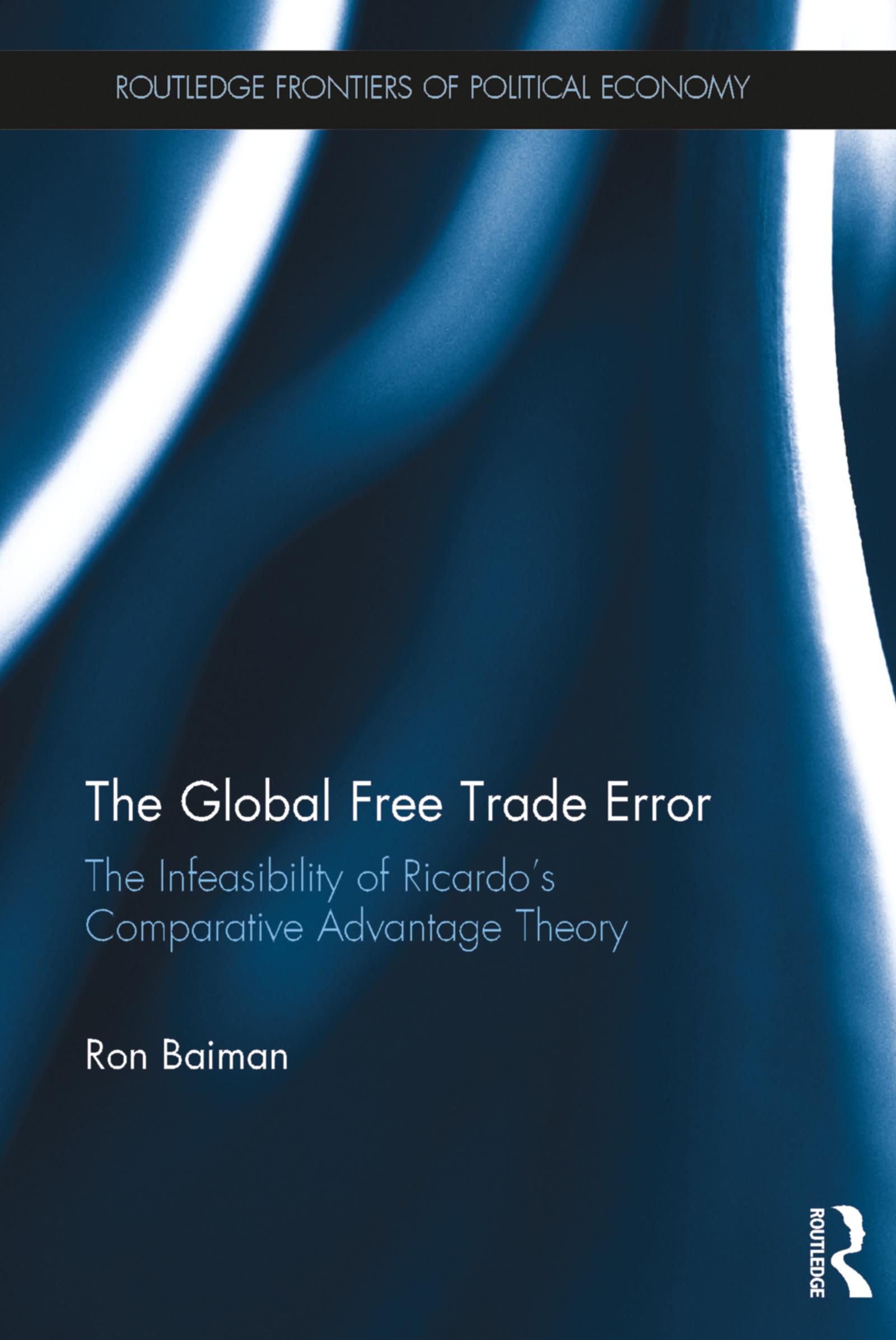
The doctrine of "free trade" is second only to that of "free markets" in undergirding ideological support for our current global economic structures and rules. From David Ricardo’s "comparative advantage principle" to James Meade’s Neoclassical or mainstream economics proof of self-adjusting free trade equilibrium, the free trade doctrine has had a lasting and destructive hold on Neoclassical economic thinking since its inception.
The Global Free Trade Error provides a detailed analysis of these foundational models and counter-poses these to alternative Neo-Marxist "unequal exchange" models of global trade and finance. In the first part of the book the three core free trade models alluded to above are respectively demonstrated to be: overdetermined, inapplicable, and infeasible. In particular, Ricardo’s parable is shown to support managed trade rather than free trade as Ricardo and two centuries of economic texts have claimed. In the second part of the book, unequal exchange analyses of global trade are shown to provide logically coherent and useful insights into global trade and finance. In the third and final part of the book, this unequal exchange perspective is used, within a general "demand and cost" setting, to develop a set of global managed trade principles for a more equitable and sustainable world trade regime.
This book will be of great interest to those who study political economy, history of economic thought, and international trade, including trade agreements and tariffs.
Betal nemt med kort, Klarna, Apple Pay eller Google Pay. Ikke tilfreds? Du har altid 14 dages fortrydelsesret. Læs mere i vores vilkår. Har du spørgsmål, så send os en mail på hello@memmo.org.
Memmo gør det nemmere at studere – uanset hvor du er i verden. Hos os samler du dine kursusbøger og smarte studieværktøjer ét sted: resuméer, quizzer, podcasts og flashcards. Og så er der Ted, din studieven, der svarer på alt, du undrer dig over. Over 50 000 studerende studerer allerede her – bygget til at hjælpe dig med at lære hurtigere og stresse mindre.