
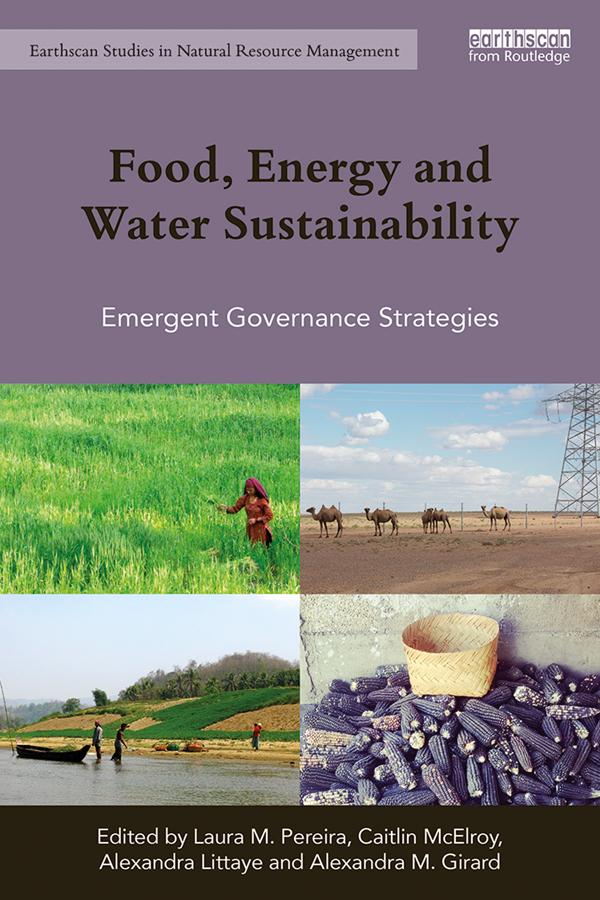
Societies around the world face an increasingly uncertain future as social and ecological changes create pressure on resource governance, and this uncertainty calls for new models that illuminate the intersections of civil society, public sector, and private sector resource management. This volume presents a diversity of collaborations between various governance actors in the management of the Food-Energy-Water (FEW) nexus. It analyses the ability of emergent governance structures to cope with the complexity of future challenges across FEW systems.
Divided into two sections, chapters in the first half of the book present a collection of case studies from around the world exemplifying how FEW nexus challenges are addressed in a multitude of ways and by a variety of actors. Chapters in the second half offer broader perspectives on the management of FEW and underline the lessons that emerge from applying a FEW lens to the question of natural resource governance.
The varied examples in this book highlight that the management of FEW is often a question of reinventing, adapting, and building upon existing practices. Such practices are deeply embedded in unique socio-cultural, environmental, and political contexts as well as ‘hard’ infrastructures. Most of all, this edited volume seeks to communicate the wealth of ideas from committed individuals who continue to work to improve natural resource governance and our sustainable futures.
Betal nemt med kort, Klarna, Apple Pay eller Google Pay. Ikke tilfreds? Du har altid 14 dages fortrydelsesret. Læs mere i vores vilkår. Har du spørgsmål, så send os en mail på hello@memmo.org.
Memmo gør det nemmere at studere – uanset hvor du er i verden. Hos os samler du dine kursusbøger og smarte studieværktøjer ét sted: resuméer, quizzer, podcasts og flashcards. Og så er der Ted, din studieven, der svarer på alt, du undrer dig over. Over 50 000 studerende studerer allerede her – bygget til at hjælpe dig med at lære hurtigere og stresse mindre.