
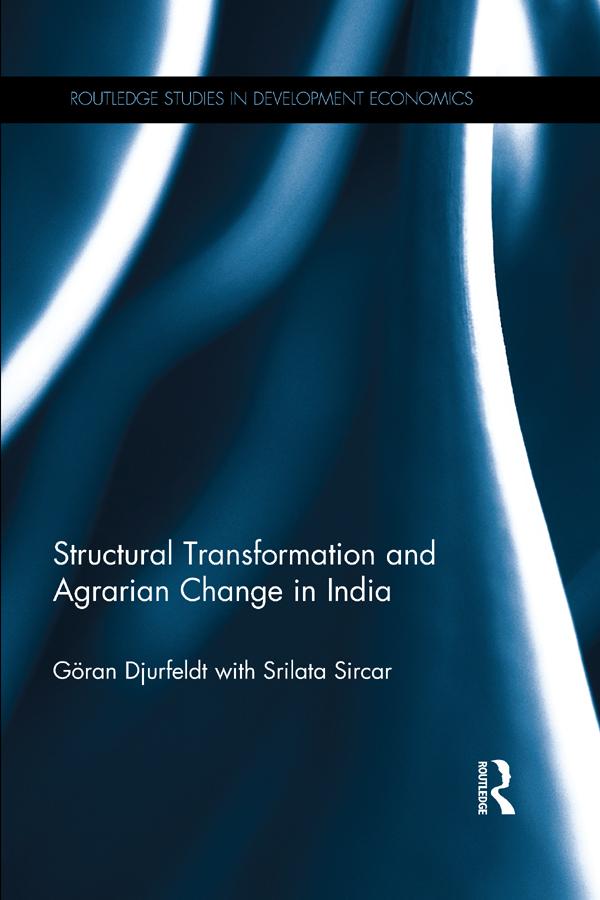
The landlord and his emaciated labourer are symbolic of Indian agriculture. However, this relationship has now changed as large landowners have fallen from their superior position. This volume explores how this emblematic pair is becoming a thing of the past.
Structural Transformation and Agrarian Change in India investigates whether family labour farms are gaining prominence as a consequence of the structural transformation of the economy. The authors work alongside Weberian methodology of ideal types and develop different types of family farms; among them family labour farms that rely mainly on family workers, contrasted with capitalist farms that depend on hired labour. Agriculture is shrinking as a part of the total GDP at the same time as agricultural labour is shrinking as part of the total labour force. The changing agrarian structure is explored with the use of unique long-term survey data and statistical models. Results show that India is approaching farm structures that are typical of East and South East Asia, with pluriactive smallholders as the norm.
This book successfully criticizes popular narratives about Indian agricultural development as well as simplistic evolutionist, Marxist or neoclassical prognoses. It is of great importance to those who study development economics, development studies and South Asian economics.
Betal nemt med kort, Klarna, Apple Pay eller Google Pay. Ikke tilfreds? Du har altid 14 dages fortrydelsesret. Læs mere i vores vilkår. Har du spørgsmål, så send os en mail på hello@memmo.org.
Memmo gør det nemmere at studere – uanset hvor du er i verden. Hos os samler du dine kursusbøger og smarte studieværktøjer ét sted: resuméer, quizzer, podcasts og flashcards. Og så er der Ted, din studieven, der svarer på alt, du undrer dig over. Over 50 000 studerende studerer allerede her – bygget til at hjælpe dig med at lære hurtigere og stresse mindre.