
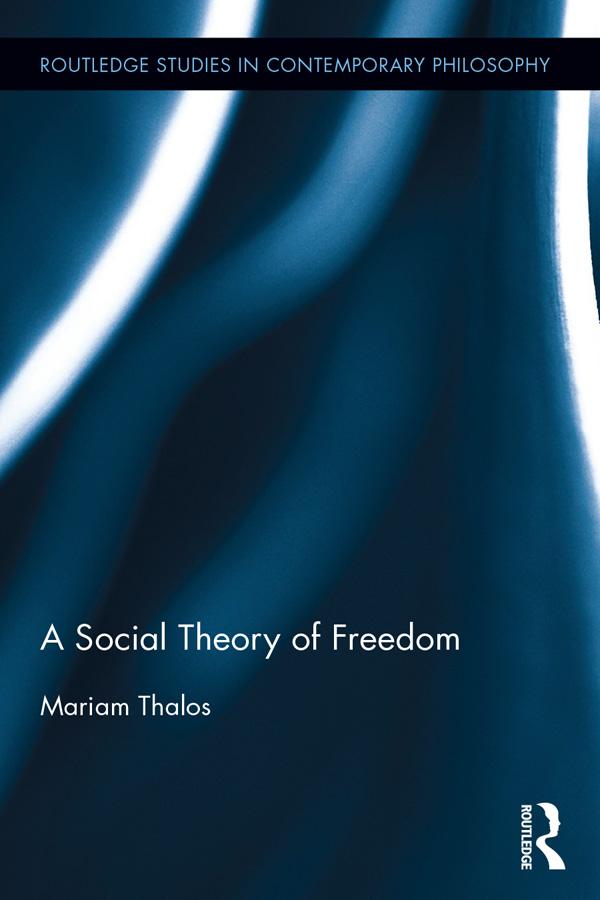
In A Social Theory of Freedom, Mariam Thalos argues that the theory of human freedom should be a broadly social and political theory, rather than a theory that places itself in opposition to the issue of determinism. Thalos rejects the premise that a theory of freedom is fundamentally a theory of the metaphysics of constraint and, instead, lays out a political conception of freedom that is closely aligned with questions of social identity, self-development in contexts of intimate relationships, and social solidarity. Thalos argues that whether a person is free (in any context) depends upon a certain relationship of fit between that agent’s conception of themselves (both present and future), on the one hand, and the facts of their circumstances, on the other. Since relationships of fit are broadly logical, freedom is a logic—it is the logic of fit between one’s aspirations and one’s circumstances, what Thalos calls the logic of agency. The logic of agency, once fleshed out, becomes a broadly social and political theory that encompasses one’s self-conceptions as well as how these self-conceptions are generated, together with how they fit with the circumstances of one’s life. The theory of freedom proposed in this volume is fundamentally a political one.
Betal nemt med kort, Klarna, Apple Pay eller Google Pay. Ikke tilfreds? Du har altid 14 dages fortrydelsesret. Læs mere i vores vilkår. Har du spørgsmål, så send os en mail på hello@memmo.org.
Memmo gør det nemmere at studere – uanset hvor du er i verden. Hos os samler du dine kursusbøger og smarte studieværktøjer ét sted: resuméer, quizzer, podcasts og flashcards. Og så er der Ted, din studieven, der svarer på alt, du undrer dig over. Over 50 000 studerende studerer allerede her – bygget til at hjælpe dig med at lære hurtigere og stresse mindre.