
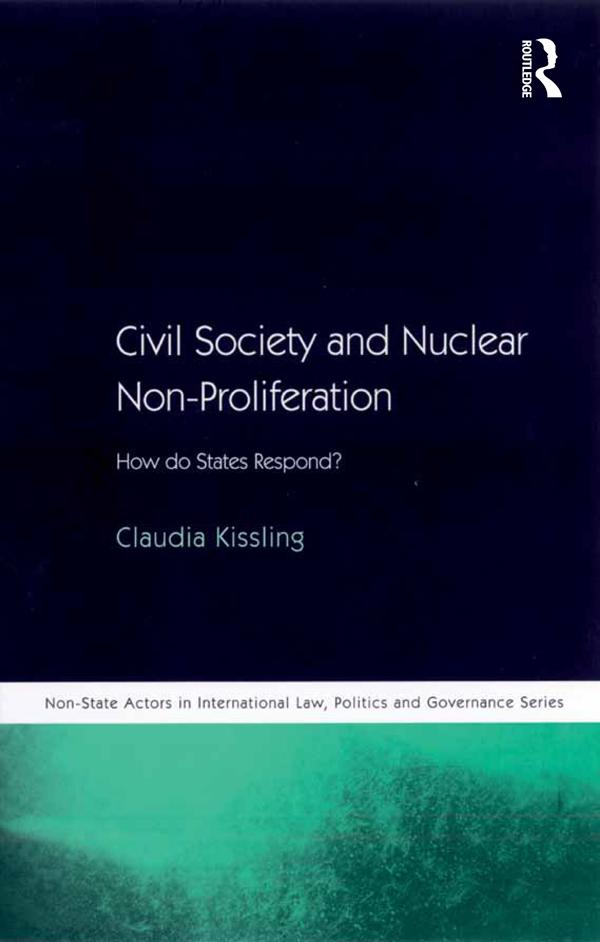
Since the end of the Cold War, globalization has brought new actors to the political arena. One of those which has attracted considerable attention in academic research is civil society or NGOs. Claudia Kissling addresses the topic of civil society participation in the nuclear non-proliferation regime. The regime qualifies well for this objective since it features, given its characteristics as a treaty regime in the international security field, notable legal avenues for civil society participation. The study takes on a twofold perspective. It addresses the empirical question of whether civil society can contribute to the evolution of regimes in the security field, especially when it comes to security cooperation. It also questions whether civil society can, under certain conditions, contribute to the democratic quality of international decision-making. Here, empirical findings are used in order to test normative political theories on the legitimacy and democracy of global institutions.
Betal nemt med kort, Klarna, Apple Pay eller Google Pay. Ikke tilfreds? Du har altid 14 dages fortrydelsesret. Læs mere i vores vilkår. Har du spørgsmål, så send os en mail på hello@memmo.org.
Memmo gør det nemmere at studere – uanset hvor du er i verden. Hos os samler du dine kursusbøger og smarte studieværktøjer ét sted: resuméer, quizzer, podcasts og flashcards. Og så er der Ted, din studieven, der svarer på alt, du undrer dig over. Over 50 000 studerende studerer allerede her – bygget til at hjælpe dig med at lære hurtigere og stresse mindre.
Du kan måske også lide
Køb bogen0