
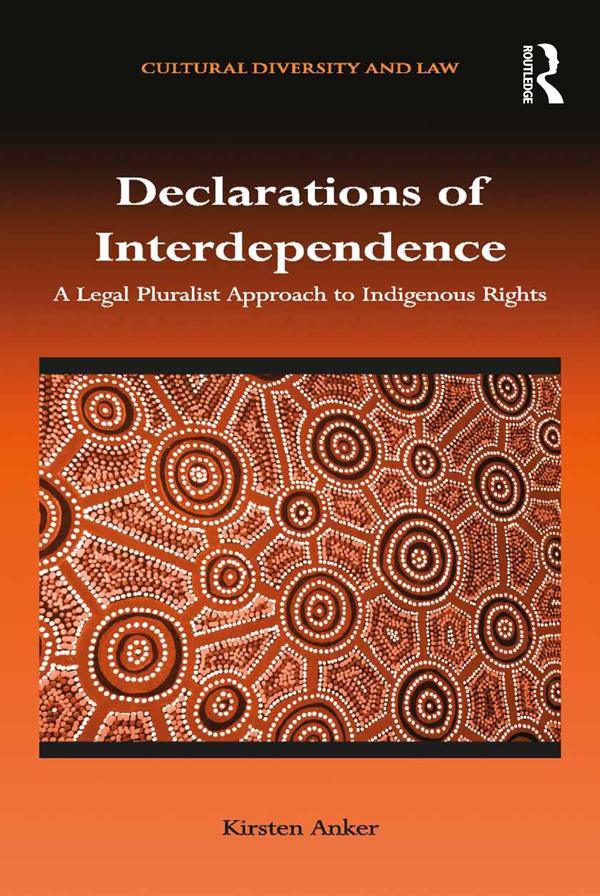
This book takes up the postcolonial challenge for law and explains how the problems of legal recognition for Indigenous peoples are tied to an orthodox theory of law. Constructing a theory of legal pluralism that is both critical of law's epistemological and ontological presuppositions, as well as discursive in engaging a dialogue between legal traditions, Anker focusses on prominent aspects of legal discourse and process such as sovereignty, proof, cultural translation and negotiation. With case studies and examples principally drawn from Australia and Canada, the book seeks to set state law in front of its own reflection in the mirror of Indigenous rights, drawing on a broad base of scholarship in addition to legal theory, from philosophy, literary studies, anthropology, social theory, Indigenous studies and art. As a contribution to legal theory, the study advances legal pluralist approaches not just by imagining a way to ’make space for’ Indigenous legal traditions, but by actually working with their insights in building theory. The book will be of value to students and researchers interested in Indigenous rights as well as those working in the areas of socio-legal studies, legal pluralism and law and cultural diversity.
Betal nemt med kort, Klarna, Apple Pay eller Google Pay. Ikke tilfreds? Du har altid 14 dages fortrydelsesret. Læs mere i vores vilkår. Har du spørgsmål, så send os en mail på hello@memmo.org.
Memmo gør det nemmere at studere – uanset hvor du er i verden. Hos os samler du dine kursusbøger og smarte studieværktøjer ét sted: resuméer, quizzer, podcasts og flashcards. Og så er der Ted, din studieven, der svarer på alt, du undrer dig over. Over 50 000 studerende studerer allerede her – bygget til at hjælpe dig med at lære hurtigere og stresse mindre.
Du kan måske også lide
Køb bogen0