
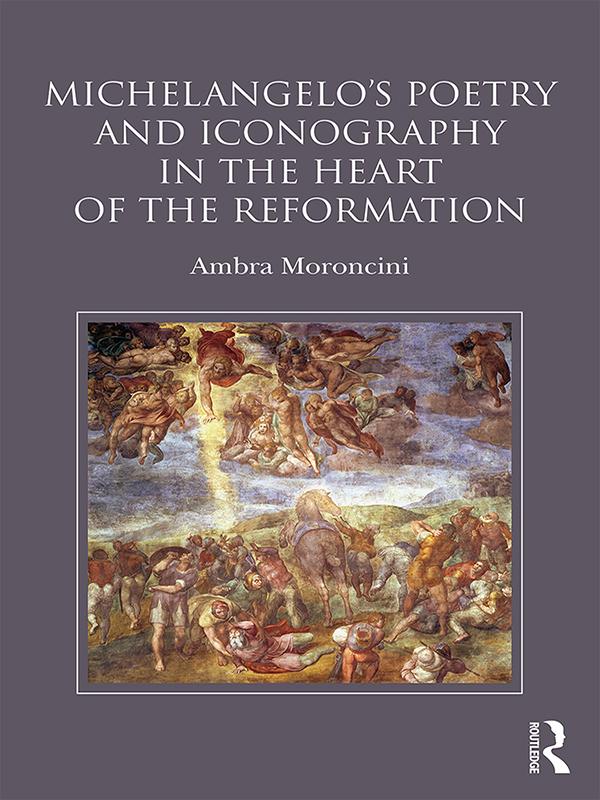
Contextualizing Michelangelo’s poetry and spirituality within the framework of the religious Zeitgeist of his era, this study investigates his poetic production to shed new light on the artist’s religious beliefs and unique language of art. Author Ambra Moroncini looks first and foremost at Michelangelo the poet and proposes a thought-provoking reading of Michelangelo’s most controversial artistic production between 1536 and c.1550: The Last Judgment, his devotional drawings made for Vittoria Colonna, and his last frescoes for the Pauline Chapel. Using theological and literary analyses which draw upon reformist and Protestant scriptural writings, as well as on Michelangelo’s own rime spirituali and Vittoria Colonna’s spiritual lyrics, Moroncini proposes a compelling argument for the impact that the Reformation had on one of the greatest minds of the Italian Renaissance. It brings to light how, in the second quarter of the sixteenth century in Italy, Michelangelo’s poetry and aesthetic conception were strongly inspired by the revived theologia crucis of evangelical spirituality, rather than by the theologia gloriae of Catholic teaching.
Betal nemt med kort, Klarna, Apple Pay eller Google Pay. Ikke tilfreds? Du har altid 14 dages fortrydelsesret. Læs mere i vores vilkår. Har du spørgsmål, så send os en mail på hello@memmo.org.
Memmo gør det nemmere at studere – uanset hvor du er i verden. Hos os samler du dine kursusbøger og smarte studieværktøjer ét sted: resuméer, quizzer, podcasts og flashcards. Og så er der Ted, din studieven, der svarer på alt, du undrer dig over. Over 50 000 studerende studerer allerede her – bygget til at hjælpe dig med at lære hurtigere og stresse mindre.