
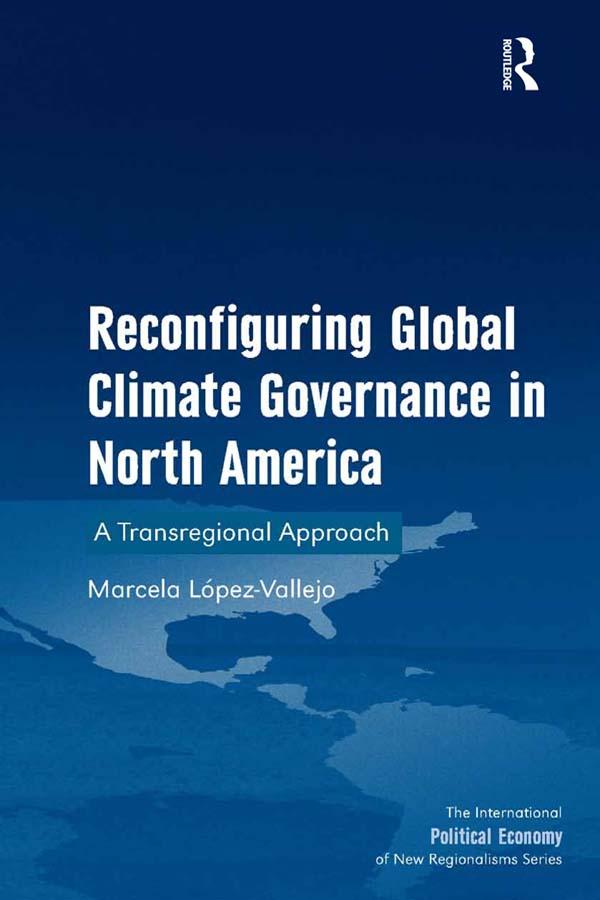
Global climate governance has presented problems that have led to failures, yet it has also opened the door to new transregional governance schemes, especially in North America. This book introduces an environmental dimension into the concept of governance. Almost fifteen years after the climate global governance concept emerged, results worldwide have not been as favorable as expected. This book details previous discussions about the concept of global climate governance and its limits. It highlights how the Kyoto Protocol has a limited design taking into account a national approach to global, regional, and transnational problems, had no obligatory mechanisms for implementation and explains the emergence of new polluters not committed under it such as China and India. Furthermore this book explores other levels of authority such as regional institutions - the North American agreement on trade (NAFTA) and on environment (NAAEC), as well as the regional energy working group (NAEWG). The author puts forward a theoretical proposal for re-territorialization and coordination of policies for climate change into new forms of articulating interests in what she terms transnational green economic regions (TGERs) and tests this on two case studies - the Regional Greenhouse Gas Initiative (RGGI) and the Western Climate Initiative (WCI). This study presents the challenges and opportunities of a transregional approach in North America.
Betal nemt med kort, Klarna, Apple Pay eller Google Pay. Ikke tilfreds? Du har altid 14 dages fortrydelsesret. Læs mere i vores vilkår. Har du spørgsmål, så send os en mail på hello@memmo.org.
Memmo gør det nemmere at studere – uanset hvor du er i verden. Hos os samler du dine kursusbøger og smarte studieværktøjer ét sted: resuméer, quizzer, podcasts og flashcards. Og så er der Ted, din studieven, der svarer på alt, du undrer dig over. Over 50 000 studerende studerer allerede her – bygget til at hjælpe dig med at lære hurtigere og stresse mindre.
Du kan måske også lide
Køb bogen0