
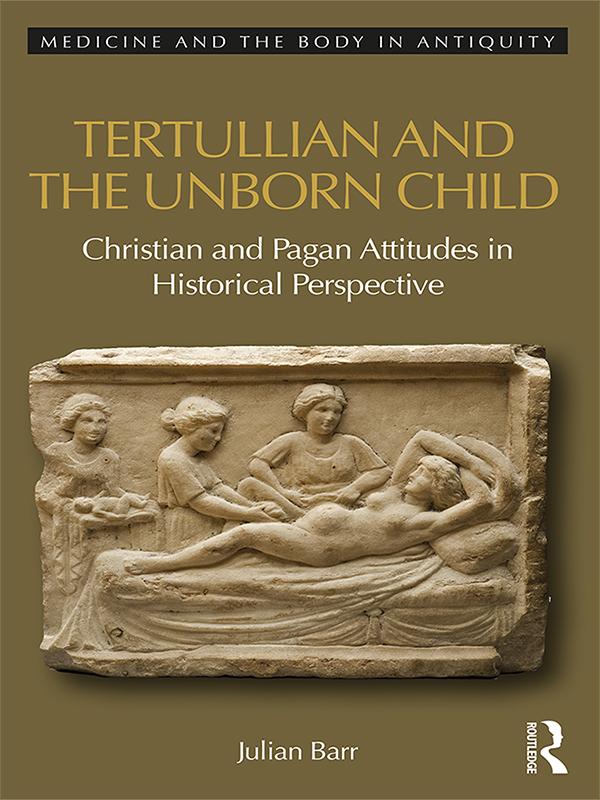
Tertullian of Carthage was the earliest Christian writer to argue against abortion at length, and the first surviving Latin author to consider the unborn child in detail. This book is the first comprehensive analysis of Tertullian’s attitude towards the foetus and embryo. Examining Tertullian’s works in light of Roman literary and social history, Julian Barr proposes that Tertullian's comments on the unborn should be read as rhetoric ancillary to his primary arguments. Tertullian’s engagement in the art of rhetoric also explains his tendency towards self-contradiction. He argued that human existence began at conception in some treatises and not in others. Tertullian’s references to the unborn hence should not be plucked out of context, lest they be misread. Tertullian borrowed, modified, and discarded theories of ensoulment according to their usefulness for individual treatises. So long as a single work was internally consistent, Tertullian was satisfied. He elaborated upon previous Christian traditions and selectively borrowed from ancient embryological theory to prove specific theological and moral points. Tertullian was more influenced by Roman custom than he would perhaps have admitted, since the contrast between pagan and Christian attitudes on abortion was more rhetorical than real.
Betal nemt med kort, Klarna, Apple Pay eller Google Pay. Ikke tilfreds? Du har altid 14 dages fortrydelsesret. Læs mere i vores vilkår. Har du spørgsmål, så send os en mail på hello@memmo.org.
Memmo gør det nemmere at studere – uanset hvor du er i verden. Hos os samler du dine kursusbøger og smarte studieværktøjer ét sted: resuméer, quizzer, podcasts og flashcards. Og så er der Ted, din studieven, der svarer på alt, du undrer dig over. Over 50 000 studerende studerer allerede her – bygget til at hjælpe dig med at lære hurtigere og stresse mindre.