
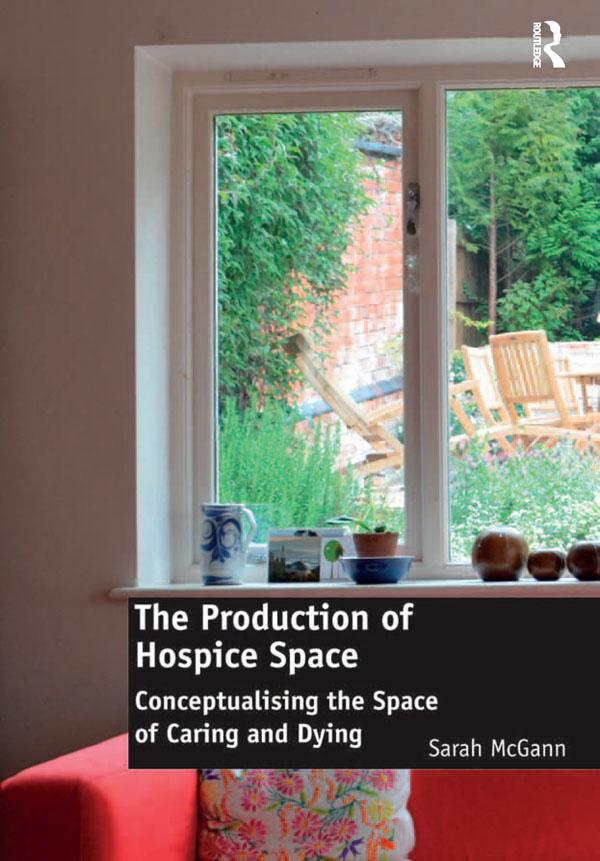
Challenging the widely held notion of a hospice as a building or a place, this book argues that it should instead be a philosophy of care. It proposes that the positive and negative impact that space can have in the pursuit of an ideal such as hospice care has previously been underestimated. Whether it be a purpose-built hospice, part of a hospital, a nursing home or within the home, a hospice is anchored by space and spatial practices, and these spatial practices are critical for a holistic approach to dying with dignity. Such spatial practices are understood as part of a broad architectural, social, conceptual and theoretical process. By linking health, social and architectural theory and establishing conceptual principles, this book defines 'hospice' as a philosophy that is underpinned by space and spatial practice. In putting forward the notion of 'hospice space', removed from the bounds of a specific building type, it suggests that hospice philosophy could and should be available within any setting of choice where the spatial practices support that philosophy, be it home, nursing home, hospice or 'hospice-friendly-hospitals'.
Betal nemt med kort, Klarna, Apple Pay eller Google Pay. Ikke tilfreds? Du har altid 14 dages fortrydelsesret. Læs mere i vores vilkår. Har du spørgsmål, så send os en mail på hello@memmo.org.
Memmo gør det nemmere at studere – uanset hvor du er i verden. Hos os samler du dine kursusbøger og smarte studieværktøjer ét sted: resuméer, quizzer, podcasts og flashcards. Og så er der Ted, din studieven, der svarer på alt, du undrer dig over. Over 50 000 studerende studerer allerede her – bygget til at hjælpe dig med at lære hurtigere og stresse mindre.
Du kan måske også lide
Køb bogen0