
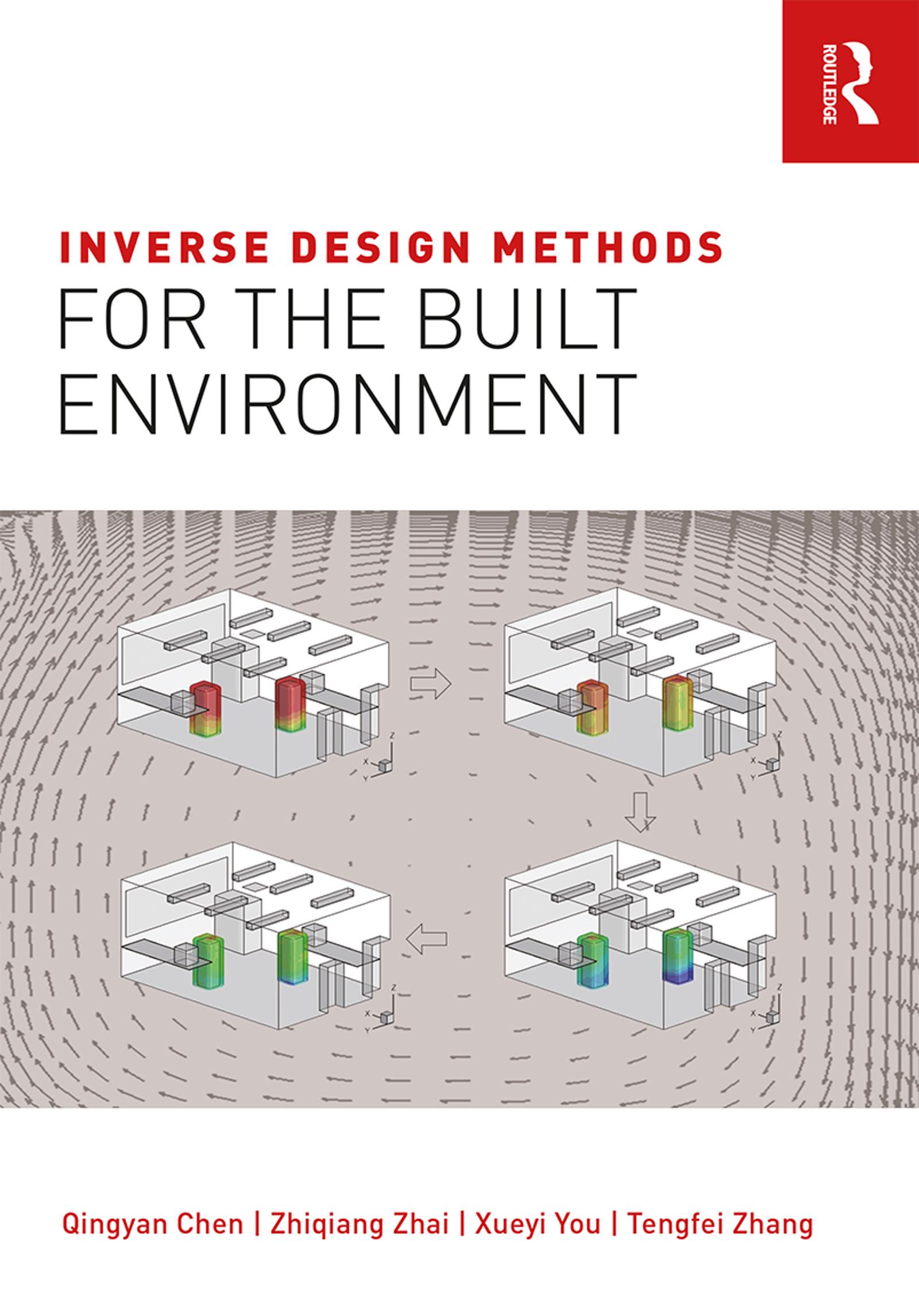
The inverse design approach is new to the built environment research and design community, though it has been used in other industries including automobile and airplane design. This book, from some of the pioneers of inverse design applications in the built environment, introduces the basic principles of inverse design and the specific techniques that can be applied to built environment systems. The authors' inverse design concept uses the desired enclosed environment as the design objective and inversely determines the systems required to achieve the objective.
The book discusses a number of backward and forward methods for inverse design. Backward methods, such as the quasi-reversibility method, the pseudo-reversibility method, and the regularized inverse matrix method, can be used to identify contaminant sources in an enclosed environment. However, these methods cannot be used to inversely design a desired indoor environment. Forward methods, such as the computational-fluid-dynamics (CFD)-based genetic algorithm (GA) method, the CFD-based adjoint method, the CFD-based artificial neural network (ANN) method, and the CFD-based proper orthogonal decomposition (POD) method, show the promise in the inverse design of airflow and heat transfer in an enclosed environment.
The book describes the fundamentals of the methods for beginners, provides exciting design examples for the reader to duplicate, discusses the pros and cons of each design method and points out the knowledge gaps for further development.
Betal nemt med kort, Klarna, Apple Pay eller Google Pay. Ikke tilfreds? Du har altid 14 dages fortrydelsesret. Læs mere i vores vilkår. Har du spørgsmål, så send os en mail på hello@memmo.org.
Memmo gør det nemmere at studere – uanset hvor du er i verden. Hos os samler du dine kursusbøger og smarte studieværktøjer ét sted: resuméer, quizzer, podcasts og flashcards. Og så er der Ted, din studieven, der svarer på alt, du undrer dig over. Over 50 000 studerende studerer allerede her – bygget til at hjælpe dig med at lære hurtigere og stresse mindre.