
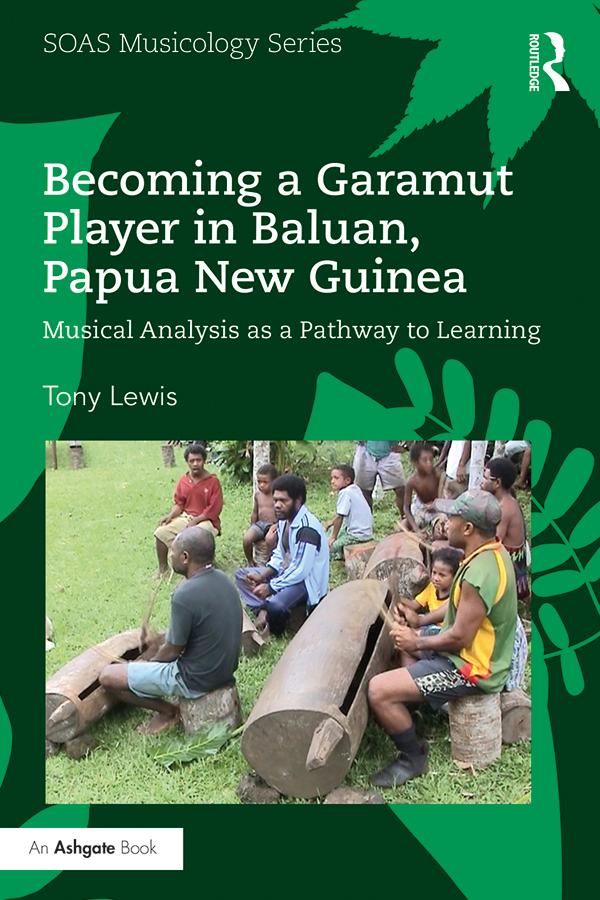
The garamut is a log idiophone that is found in many of the coastal and island areas of Papua New Guinea. The instrument’s primary use is as a speech surrogate and in some regions the garamut is also used in large ensembles to play complex music for dancing. In Baluan Island, within the Manus Province, this style of garamut playing is comparatively highly developed. This book follows the author’s processes and methods in learning to play the music of the garamut, to the level at which he became accepted as a garamut player by the people of Baluan.
Lewis argues that analysis is essential in learning to play the rapid tempi and complex rhythms of Baluan garamut music, in a cultural context where there is no formal teaching process for the music. The transcription and analysis of the Baluan garamut repertoire is the centrepiece of this study, reflecting the cognitive structures of the learning process, and revealing the inner workings of the music’s complexity as well as a striking beauty of form and structure.
The book concludes with reflections on the process of a ‘cultural outsider’ becoming a garamut player in Baluan and on the role of musical analysis in that process, on the ethnomusicologist’s role in transmission of the music, and on the nature of continuity and change in a musical society such as Baluan.
Betal nemt med kort, Klarna, Apple Pay eller Google Pay. Ikke tilfreds? Du har altid 14 dages fortrydelsesret. Læs mere i vores vilkår. Har du spørgsmål, så send os en mail på hello@memmo.org.
Memmo gør det nemmere at studere – uanset hvor du er i verden. Hos os samler du dine kursusbøger og smarte studieværktøjer ét sted: resuméer, quizzer, podcasts og flashcards. Og så er der Ted, din studieven, der svarer på alt, du undrer dig over. Over 50 000 studerende studerer allerede her – bygget til at hjælpe dig med at lære hurtigere og stresse mindre.