
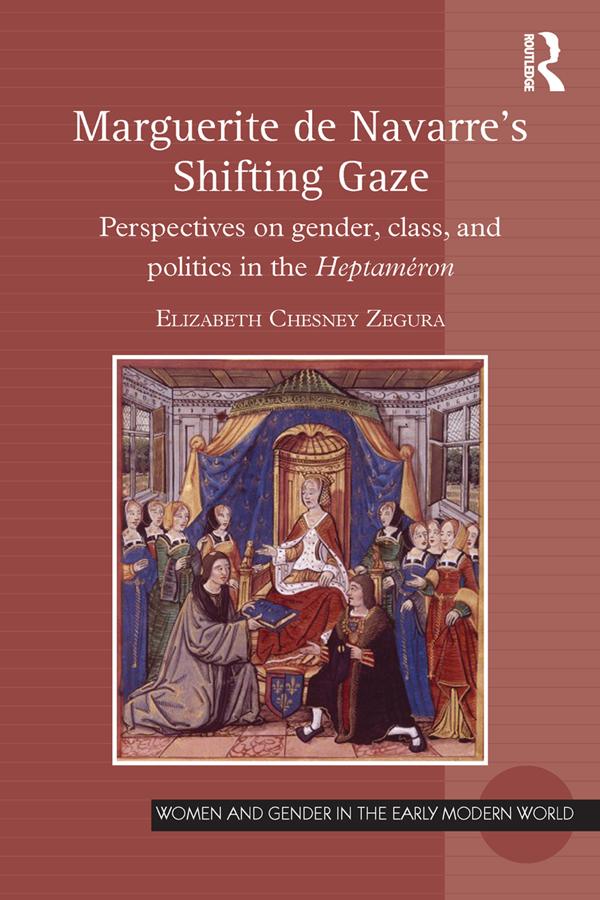
Marguerite de Navarre’s Heptaméron, composed in the 1540s and first published posthumously in 1558 and 1559, has long been an interpretive puzzle. De Navarre (1492-1549), sister of King Francis I of France, was a controversial figure in her lifetime. Her evangelical activities and proximity to the Crown placed her at the epicenter of her country’s internecine strife and societal unrest. Yet her short stories appear to offer few traces of the sociopolitical turbulence that surrounded her.In Marguerite de Navarre’s Shifting Gaze, however, Elizabeth Zegura argues that the Heptaméron’s innocuous appearance camouflages its serious insights into patriarchy and gender, social class, and early modern French politics, which emerge from an analysis of the text’s shifting perspectives. Zegura’s approach, which focuses on visual cues and alternative standpoints and viewing positions within the text, hinges upon foregrounding "les choses basses" (lowly things) to which the devisante (storyteller) Oisille draws our attention in nouvelle (novella) 2 of the Heptaméron, using this downward, archaeological gaze to excavate layers of the text that merit more extensive critical attention.While her conclusions cast a new light on the literature, life, and times of Marguerite de Navarre, they are nevertheless closely aligned with recent scholarship on this important historical and literary figure.
Betal nemt med kort, Klarna, Apple Pay eller Google Pay. Ikke tilfreds? Du har altid 14 dages fortrydelsesret. Læs mere i vores vilkår. Har du spørgsmål, så send os en mail på hello@memmo.org.
Memmo gør det nemmere at studere – uanset hvor du er i verden. Hos os samler du dine kursusbøger og smarte studieværktøjer ét sted: resuméer, quizzer, podcasts og flashcards. Og så er der Ted, din studieven, der svarer på alt, du undrer dig over. Over 50 000 studerende studerer allerede her – bygget til at hjælpe dig med at lære hurtigere og stresse mindre.