
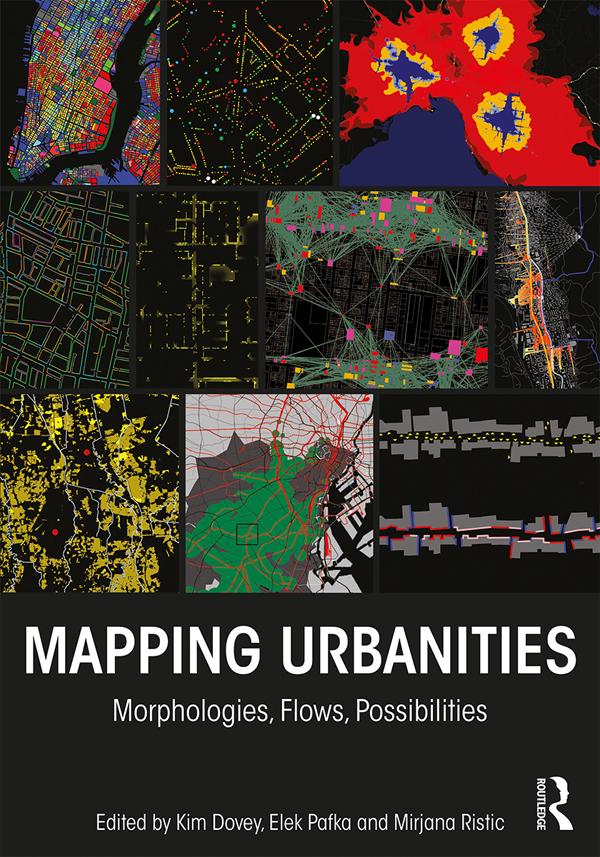
What is the capacity of mapping to reveal the forces at play in shaping urban form and space? How can mapping extend the urban imagination and therefore the possibilities for urban transformation?
With a focus on urban scales, Mapping Urbanities explores the potency of mapping as a research method that opens new horizons in our exploration of complex urban environments. A primary focus is on investigating urban morphologies and flows within a framework of assemblage thinking – an understanding of cities that is focused on relations between places rather than on places in themselves; on transformations more than fixed forms; and on multi-scale relations from 10m to 100km.
With cases drawn from 30 cities across the global north and south, Mapping Urbanities analyses the mapping of place identities, political conflict, transport flows, streetlife, functional mix and informal settlements. Mapping is presented as a production of spatial knowledge embodying a diagrammatic logic that cannot be reduced to words and numbers. Urban mapping constructs interconnections between the ways the city is perceived, conceived and lived, revealing capacities for urban transformation – the city as a space of possibility.
Betal nemt med kort, Klarna, Apple Pay eller Google Pay. Ikke tilfreds? Du har altid 14 dages fortrydelsesret. Læs mere i vores vilkår. Har du spørgsmål, så send os en mail på hello@memmo.org.
Memmo gør det nemmere at studere – uanset hvor du er i verden. Hos os samler du dine kursusbøger og smarte studieværktøjer ét sted: resuméer, quizzer, podcasts og flashcards. Og så er der Ted, din studieven, der svarer på alt, du undrer dig over. Over 50 000 studerende studerer allerede her – bygget til at hjælpe dig med at lære hurtigere og stresse mindre.