
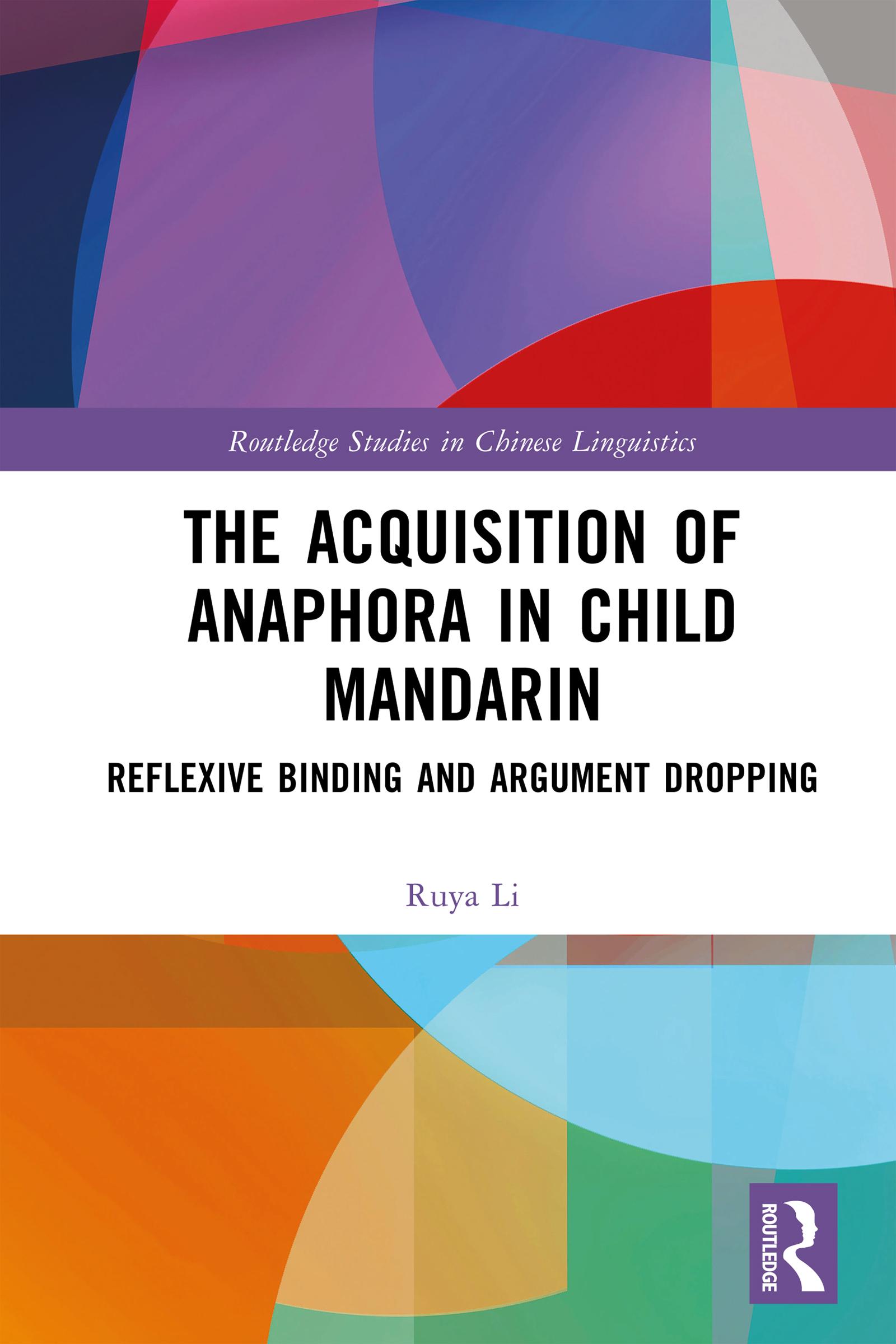
The Acquisition of Anaphora in Child Mandarin explores how Mandarin-speaking children’s interpretation of the reflexive ziji and their use of null arguments can be understood under the notions of locality and prominence.
This book investigates the interpretation of ziji and the use of null subjects and null objects by experimenting on Mandarin-speaking children and adults using a range of experimental techniques such as the truth value judgment task, the picture identification task, and the story-telling task.
The book provides evidence to show that reflexive binding and argument dropping are determined by the interplay between universal principles and language-specific properties. It shows that children at the age of 4 make an adult-like distinction between the anaphoric and logophoric interpretations of ziji. The former is subject to the locality condition manifested by the blocking effect on the long-distance binding of ziji, whereas the latter is free from the locality condition and closely related to the understanding of the false beliefs of others.
This book is an important contribution to language acquisition research and can serve as a valuable reference for graduate students and researchers in the field of language acquisition, Chinese linguistics, psycholinguistics, and cognitive science.
Betal nemt med kort, Klarna, Apple Pay eller Google Pay. Ikke tilfreds? Du har altid 14 dages fortrydelsesret. Læs mere i vores vilkår. Har du spørgsmål, så send os en mail på hello@memmo.org.
Memmo gør det nemmere at studere – uanset hvor du er i verden. Hos os samler du dine kursusbøger og smarte studieværktøjer ét sted: resuméer, quizzer, podcasts og flashcards. Og så er der Ted, din studieven, der svarer på alt, du undrer dig over. Over 50 000 studerende studerer allerede her – bygget til at hjælpe dig med at lære hurtigere og stresse mindre.