
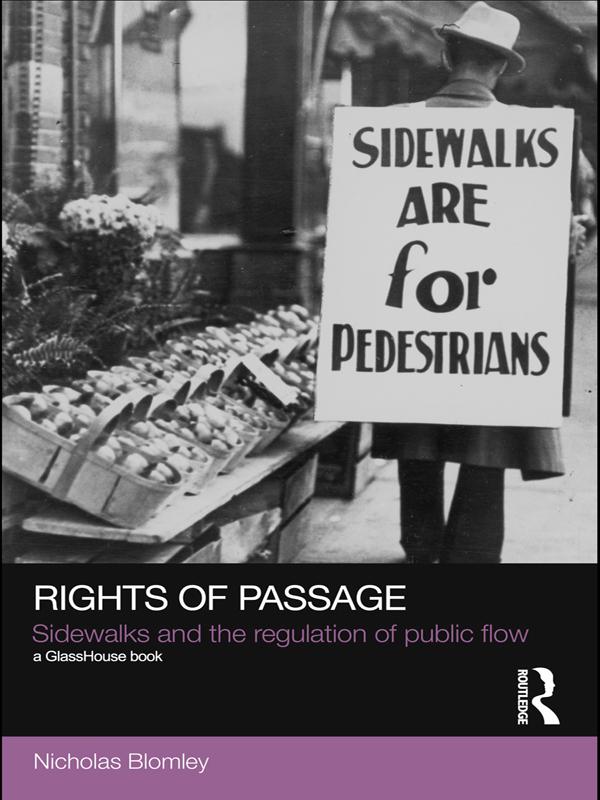
Rights of Passage: Sidewalks and the Regulation of Public Flow documents a powerful and under-researched form of urban governance that focuses on pedestrian flow. This logic, which Nicholas Blomley terms 'pedestrianism', values public space not in terms of its aesthetic merits, or its success in promoting public citizenship and democracy. Rather, the function of the sidewalk is understood to be the promotion and facilitation of pedestrian flow and circulation, predicated on the appropriate arrangement of people and objects. This remarkably pervasive yet overlooked logic shapes the ways in which public space is regulated, conceived of, and argued about. Rights of Passage shows how the sidewalk is literally produced, encoded, rendered legible and operational with reference to a dense array of codes, diagrams, specifications, academic and professional networks, engineering rubrics, regulation and case law – all in the name of unfettered circulation.
Although a powerful form of governance, pedestrianism tends to be obscured by grander and more visible forms of urban regulation. The rationality at work here may appear commonplace; but, precisely because it is uncontroversial, pedestrianism is able to operate below the academic and political radar. Complicating the prevailing tendency to focus on the socially directive nature of public space regulation, Blomley reveals the particular ways in which pedestrianism deactivates rights-based claims to public space.
Betal nemt med kort, Klarna, Apple Pay eller Google Pay. Ikke tilfreds? Du har altid 14 dages fortrydelsesret. Læs mere i vores vilkår. Har du spørgsmål, så send os en mail på hello@memmo.org.
Memmo gør det nemmere at studere – uanset hvor du er i verden. Hos os samler du dine kursusbøger og smarte studieværktøjer ét sted: resuméer, quizzer, podcasts og flashcards. Og så er der Ted, din studieven, der svarer på alt, du undrer dig over. Over 50 000 studerende studerer allerede her – bygget til at hjælpe dig med at lære hurtigere og stresse mindre.