
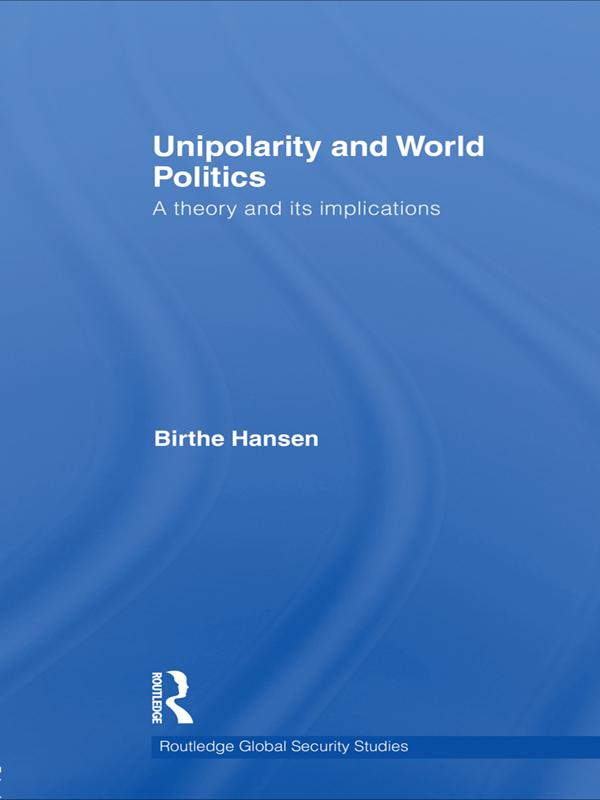
This new book offers a coherent model of a unipolar world order.
Unipolarity is usually described either as a ‘brief moment’ or as something historically insignificant. However, we have already seen nearly twenty years of virtual unipolarity and this period has been of great significance for world politics.
Two issues have been crucial since the end of the Cold War: How to theorize the distinctiveness and exceptional character of a unipolar international system? And what is it like to conduct state business in a unipolar world? Until now, a comprehensive model for unipolarity has been lacking. This volume provides a theoretical framework for analysis of the current world order and identifies the patterns of outcomes and systematic variations to be expected. Terrorism and attempts by small states to achieve a nuclear capability are not new phenomena or exclusive to the current world order, but in the case of unipolarity these have become attached to the fear of marginalization and the struggle against a powerful centre without the possibility of allying with an alternative superpower.
Supplying a coherent theoretical model for unipolarity, which can provide explanations of trends and patterns in the turbulent post-Cold War era, this book will be of interest to students of IR theory, international security and foreign policy.
Betal nemt med kort, Klarna, Apple Pay eller Google Pay. Ikke tilfreds? Du har altid 14 dages fortrydelsesret. Læs mere i vores vilkår. Har du spørgsmål, så send os en mail på hello@memmo.org.
Memmo gør det nemmere at studere – uanset hvor du er i verden. Hos os samler du dine kursusbøger og smarte studieværktøjer ét sted: resuméer, quizzer, podcasts og flashcards. Og så er der Ted, din studieven, der svarer på alt, du undrer dig over. Over 50 000 studerende studerer allerede her – bygget til at hjælpe dig med at lære hurtigere og stresse mindre.