
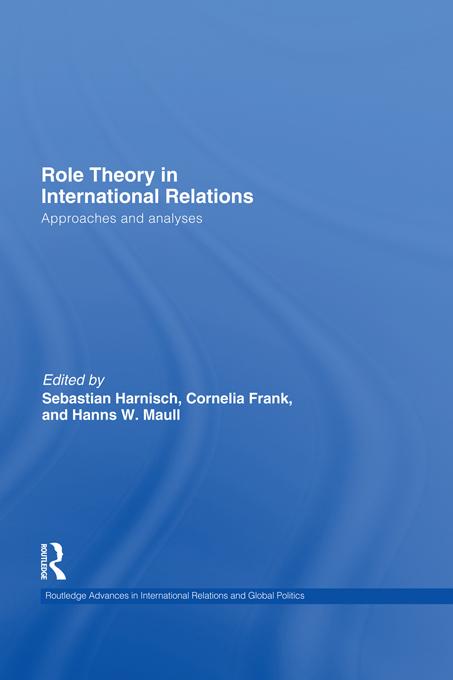
Role Theory in International Relations provides a comprehensive, up-to-date survey of recent theoretical scholarship on foreign policy roles and extensive empirical analysis of role behaviour of a variety of states in the current era of eroding American hegemony.
Taking stock of the evolution of role theory within foreign policy analysis, international relations and social science theory, the authors probe role approaches in combination with IR concepts such as socialization, learning and communicative action. They draw upon comparative case studies of foreign policy roles of states (the United States, Japan, PR China, Germany, France, UK, Poland, Sweden, and Norway) and international institutions (NATO, EU) to assess NATO’s transformation, the EU as a normative power as well as the impact of China’s rise on U.S. hegemony under the Bush and Obama administrations. The chapters also offer compelling theoretical arguments about the nexus between foreign policy role change and the evolution of the international society.
This important new volume advances current role theory scholarship, offering concrete theoretical suggestions of how foreign policy analysis and IR theory could benefit from a closer integration of role theory. It will be of great interest to all scholars and students of international relations, foreign policy and international politics.
Betal nemt med kort, Klarna, Apple Pay eller Google Pay. Ikke tilfreds? Du har altid 14 dages fortrydelsesret. Læs mere i vores vilkår. Har du spørgsmål, så send os en mail på hello@memmo.org.
Memmo gør det nemmere at studere – uanset hvor du er i verden. Hos os samler du dine kursusbøger og smarte studieværktøjer ét sted: resuméer, quizzer, podcasts og flashcards. Og så er der Ted, din studieven, der svarer på alt, du undrer dig over. Over 50 000 studerende studerer allerede her – bygget til at hjælpe dig med at lære hurtigere og stresse mindre.