
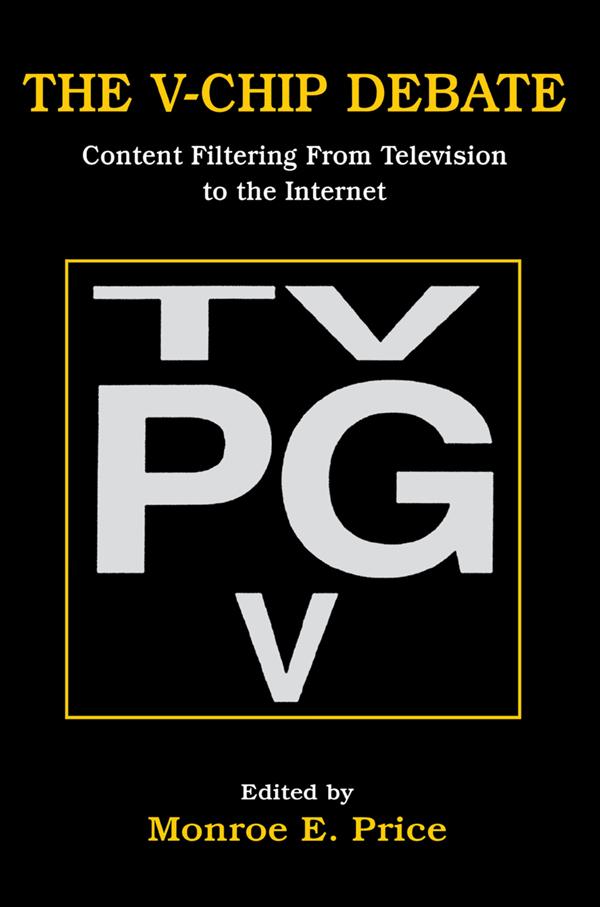
The V-chip is a highly significant part of the discussion about whether television (or broadcasting in general) deserves some special attention in terms of its accessibility to children, its particular power to affect conduct, and its invasiveness. But as this notion of filtering and labeling has caught the imagination of the regulator, the legislator, and all those who wish to consider new ways to alter bargaining over imagery in society, the very idea of the V-chip or its equivalent is moving across other technologies, including the Internet. The V-chip issue has also fueled the ongoing debate about violence and sexual practices in society, and how representations on television relate to those practices.
Although the initial concept of the V-chip is simple, its flow into the public realm raises so many extraordinary questions that the introduction and production of the chip virtually serves as a case study in problems of law and public policy. The very conceptualization of speech in society is being affected by this issue. Accordingly, the place of the V-chip in this debate is increasingly important; indeed, it may be argued that the V-chip's contribution to legal argumentation may be greater than its ultimate contribution to the relationship between children and imagery. Among the questions the contributors address are:
*What research basis is necessary to require a framework for labeling and rating?
*What relationship between government and the image-producing industries can be characterized--for constitutional and other reasons--as voluntary as opposed to coercive?
*Who should evaluate these images?
*To what extent should the evaluation process be centralized and/or distributed?
*What assessment is appropriate to evaluate whether the experiment is "successful?"
In addition to the V-chip's origin's in Canada and its further evolution in the United States, this book discusses the development of the V-chip and television rating systems in Europe, Australia, and throughout the world. It also includes essays which contrast the very different approaches in Canada and the United States in terms of the role of regulatory agency, industry, and government.
Betal nemt med kort, Klarna, Apple Pay eller Google Pay. Ikke tilfreds? Du har altid 14 dages fortrydelsesret. Læs mere i vores vilkår. Har du spørgsmål, så send os en mail på hello@memmo.org.
Memmo gør det nemmere at studere – uanset hvor du er i verden. Hos os samler du dine kursusbøger og smarte studieværktøjer ét sted: resuméer, quizzer, podcasts og flashcards. Og så er der Ted, din studieven, der svarer på alt, du undrer dig over. Over 50 000 studerende studerer allerede her – bygget til at hjælpe dig med at lære hurtigere og stresse mindre.