
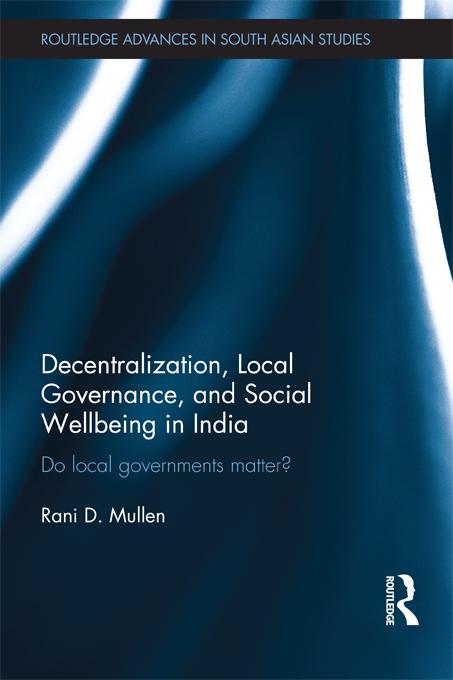
Over the past three decades, decentralization has been seen as the means for allowing local governments to become more accountable, and for encouraging the deepening of democracy and the building of village communities. By drawing on original village-level case studies of six villages in three different Indian states, this book presents a systematic analysis of the impact of decentralization on the delivery of social services at the local level within India.
Supplementing national and state-level data and analyzing the different historical legacies in each state, the book argues that decentralization is not simply a function of the structure of the decentralization program or of the relationship between higher-tiered and local government. Rather, the possibility of decentralization affecting social outcomes depends on several interacting factors, including the distribution of power among local elites, the dynamics of political competition, and the level of civil society mobilization. By examining constitutionally-mandated political decentralization across India, this book identifies the circumstances under which local government structures can lead to improved social services and societal wellbeing, as well as presenting a substantial contribution to studies on South Asian Politics and Local Government.
Betal nemt med kort, Klarna, Apple Pay eller Google Pay. Ikke tilfreds? Du har altid 14 dages fortrydelsesret. Læs mere i vores vilkår. Har du spørgsmål, så send os en mail på hello@memmo.org.
Memmo gør det nemmere at studere – uanset hvor du er i verden. Hos os samler du dine kursusbøger og smarte studieværktøjer ét sted: resuméer, quizzer, podcasts og flashcards. Og så er der Ted, din studieven, der svarer på alt, du undrer dig over. Over 50 000 studerende studerer allerede her – bygget til at hjælpe dig med at lære hurtigere og stresse mindre.