
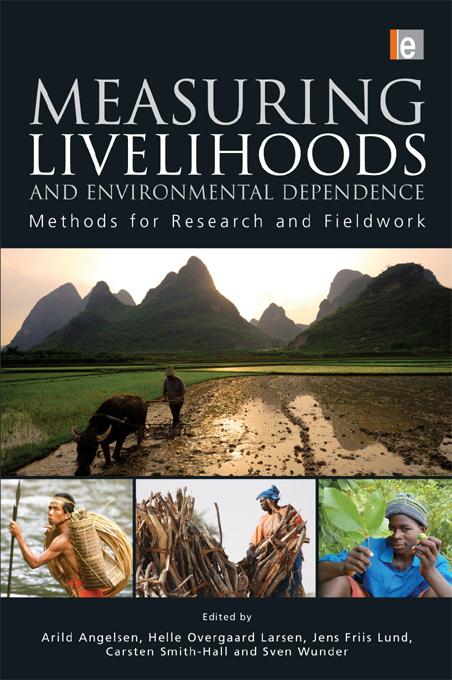
Thousands of surveys on rural livelihoods in developing countries are being done every year. Unfortunately, many suffer from weaknesses in methods and problems in implementation. Quantifying households' dependence on multiple environmental resources (forests, bush, grasslands and rivers) is particularly difficult and often simply ignored in the surveys. The results therefore do not reflect rural realities. In particular, 'the hidden harvest' from natural resources is generally too important to livelihoods for development research, policies and practice to ignore. Fieldwork using state-of-the-art methods, and in particular well-designed household questionnaires, thus becomes an imperative to adequately capture key dimensions of rural welfare.
This book describes how to do a better job when designing and implementing household and village surveys for quantitative assessment of rural livelihoods in developing countries. It covers the entire research process from planning to sharing research results. It draws on the experiences from a large global-comparative project, the Poverty Environment Network (PEN), to develop more robust and validated methods, enriched by numerous practical examples from the field. The book will provide an invaluable guide to methods and a practical handbook for students and professionals.
Betal nemt med kort, Klarna, Apple Pay eller Google Pay. Ikke tilfreds? Du har altid 14 dages fortrydelsesret. Læs mere i vores vilkår. Har du spørgsmål, så send os en mail på hello@memmo.org.
Memmo gør det nemmere at studere – uanset hvor du er i verden. Hos os samler du dine kursusbøger og smarte studieværktøjer ét sted: resuméer, quizzer, podcasts og flashcards. Og så er der Ted, din studieven, der svarer på alt, du undrer dig over. Over 50 000 studerende studerer allerede her – bygget til at hjælpe dig med at lære hurtigere og stresse mindre.