
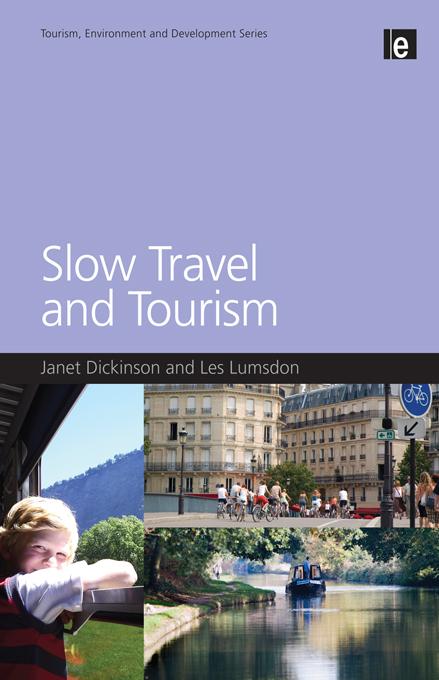
It is widely recognized that travel and tourism can have a high environmental impact and make a major contribution to climate change. It is therefore vital that ways to reduce these impacts are developed and implemented. 'Slow travel' provides such a concept, drawing on ideas from the 'slow food' movement with a concern for locality, ecology and quality of life.
The aim of this book is to define slow travel and to discuss how some underlining values are likely to pervade new forms of sustainable development. It also aims to provide insights into the travel experience; these are explored in several chapters which bring new knowledge about sustainable transport tourism from across the world. In order to do this the book explores the concept of slow travel and sets out its core ingredients, comparing it with related frameworks such as low-carbon tourism and sustainable tourism development. The authors explain slow travel as holiday travel where air and car transport is rejected in favour of more environmentally benign forms of overland transport, which generally take much longer and become incorporated as part of the holiday experience. The book critically examines the key trends in tourism transport and recent climate change debates, setting out the main issues facing tourism planners. It reviews the potential for new consumption patterns, as well as current business models that facilitate hyper-mobility. This provides a cutting edge critique of the 'upstream' drivers to unsustainable tourism. Finally, the authors illustrate their approach through a series of case studies from around the world, featuring travel by train, bus, cycling and walking. Examples are drawn from Europe, Asia, Australia and the Americas. Cases include the Eurostar train (as an alternative to air travel), walking in the Appalachian Trail (US), the Euro-Velo network of long-distance cycling routes, canoe tours on the Gudena River in Denmark, sea kayaking in British Columbia (Canada) and the Oz Bus Europe to Australia.
Betal nemt med kort, Klarna, Apple Pay eller Google Pay. Ikke tilfreds? Du har altid 14 dages fortrydelsesret. Læs mere i vores vilkår. Har du spørgsmål, så send os en mail på hello@memmo.org.
Memmo gør det nemmere at studere – uanset hvor du er i verden. Hos os samler du dine kursusbøger og smarte studieværktøjer ét sted: resuméer, quizzer, podcasts og flashcards. Og så er der Ted, din studieven, der svarer på alt, du undrer dig over. Over 50 000 studerende studerer allerede her – bygget til at hjælpe dig med at lære hurtigere og stresse mindre.