
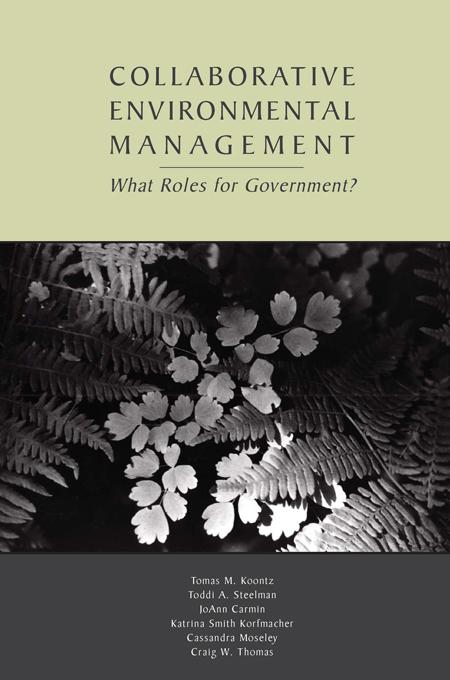
Collaboration has become a popular approach to environmental policy, planning, and management. At the urging of citizens, nongovernmental organizations, and industry, government officials at all levels have experimented with collaboration. Yet questions remain about the roles that governments play in collaboration--whether they are constructive and support collaboration, or introduce barriers. This thoughtful book analyzes a series of cases to understand how collaborative processes work and whether government can be an equal partner even as government agencies often formally control decision making and are held accountable for the outcomes. Looking at examples where government has led, encouraged, or followed in collaboration, the authors assess how governmental actors and institutions affected the way issues were defined, the resources available for collaboration, and the organizational processes and structures that were established. Cases include collaborative efforts to manage watersheds, rivers, estuaries, farmland, endangered species habitats, and forests. The authors develop a new theoretical framework and demonstrate that government left a heavy imprint in each of the efforts. The work concludes by discussing the choices and challenges faced by governmental institutions and actors as they try to realize the potential of collaborative environmental management.
Betal nemt med kort, Klarna, Apple Pay eller Google Pay. Ikke tilfreds? Du har altid 14 dages fortrydelsesret. Læs mere i vores vilkår. Har du spørgsmål, så send os en mail på hello@memmo.org.
Memmo gør det nemmere at studere – uanset hvor du er i verden. Hos os samler du dine kursusbøger og smarte studieværktøjer ét sted: resuméer, quizzer, podcasts og flashcards. Og så er der Ted, din studieven, der svarer på alt, du undrer dig over. Over 50 000 studerende studerer allerede her – bygget til at hjælpe dig med at lære hurtigere og stresse mindre.
Du kan måske også lide
Køb bogen0