
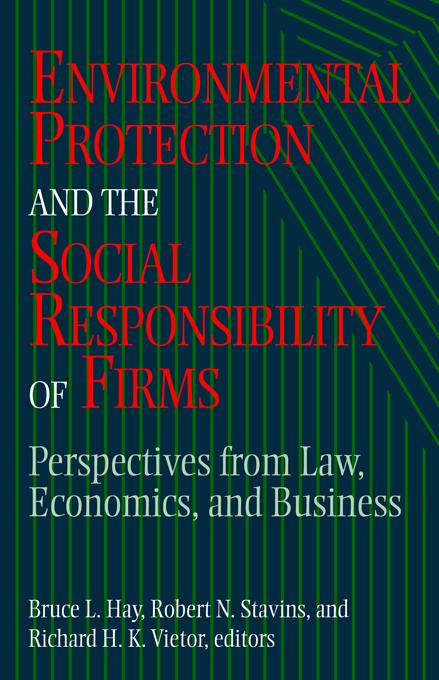
Everyone agrees that firms should obey the law. But beyond what the law requires-beyond bare compliance with regulations-do firms have additional social responsibilities to commit resources voluntarily to environmental protection? How should we think about firms sacrificing profits in the social interest? Are they permitted to do so, given their fiduciary responsibilities to their shareholders? Even if permissible, is the practice sustainable, or will the competitive marketplace render such efforts and their impacts transient at best? Furthermore, is the practice, however well intended, an efficient use of social and economic resources? And, as an empirical matter, to what extent do firms already behave this way? Until now, public discussion has generated more heat than light on both the normative and positive questions surrounding corporate social responsibility (CSR) in the environmental realm. In Environmental Protection and the Social Responsibility of Firms, some of the nation‘s leading scholars in law, economics, and business examine commonly accepted assumptions at the heart of current debates on corporate social responsibility and provide a foundation for future research and policymaking.
Betal nemt med kort, Klarna, Apple Pay eller Google Pay. Ikke tilfreds? Du har altid 14 dages fortrydelsesret. Læs mere i vores vilkår. Har du spørgsmål, så send os en mail på hello@memmo.org.
Memmo gør det nemmere at studere – uanset hvor du er i verden. Hos os samler du dine kursusbøger og smarte studieværktøjer ét sted: resuméer, quizzer, podcasts og flashcards. Og så er der Ted, din studieven, der svarer på alt, du undrer dig over. Over 50 000 studerende studerer allerede her – bygget til at hjælpe dig med at lære hurtigere og stresse mindre.
Du kan måske også lide
Køb bogen0