
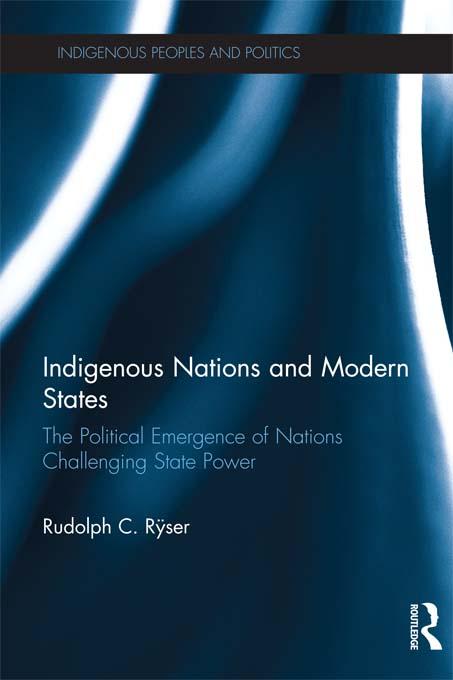
Indigenous peoples throughout the world tenaciously defend their lands, cultures, and their lives with resilience and determination. They have done so generation after generation. These are peoples who make up bedrock nations throughout the world in whose territories the United Nations says 80 percent of the world’s life sustaining biodiversity remains. Once thought of as remnants of a human past that would soon disappear in the fog of history, indigenous peoples—as we now refer to them—have in the last generation emerged as new political actors in global, regional and local debates. As countries struggle with economic collapse, terrorism and global warming indigenous peoples demand a place at the table to decide policy about energy, boundaries, traditional knowledge, climate change, intellectual property, land, environment, clean water, education, war, terrorism, health and the role of democracy in society.
In this volume Rudolph C. Ryser describes how indigenous peoples transformed themselves from anthropological curiosities into politically influential voices in domestic and international deliberations affecting everyone on the planet. He reveals in documentary detail how since the 1970s indigenous peoples politically formed governing authorities over peoples, territories and resources raising important questions and offering new solutions to profound challenges to human life.
Betal nemt med kort, Klarna, Apple Pay eller Google Pay. Ikke tilfreds? Du har altid 14 dages fortrydelsesret. Læs mere i vores vilkår. Har du spørgsmål, så send os en mail på hello@memmo.org.
Memmo gør det nemmere at studere – uanset hvor du er i verden. Hos os samler du dine kursusbøger og smarte studieværktøjer ét sted: resuméer, quizzer, podcasts og flashcards. Og så er der Ted, din studieven, der svarer på alt, du undrer dig over. Over 50 000 studerende studerer allerede her – bygget til at hjælpe dig med at lære hurtigere og stresse mindre.