
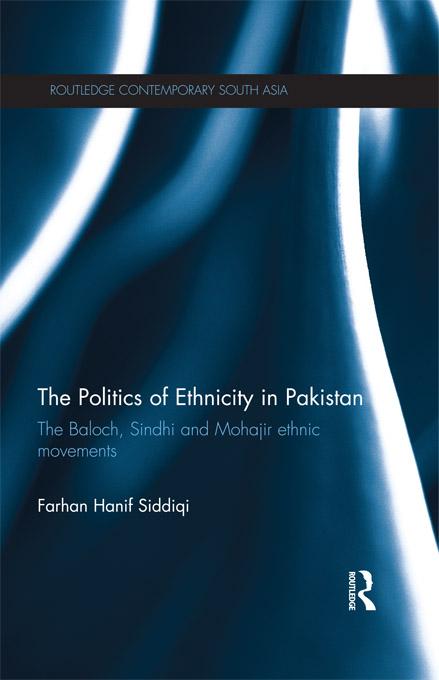
In order to understand the Pakistani state and government’s treatment of non-dominant ethnic groups after the failure of the military operation in East Pakistan and the independence of Bangladesh, this book looks at the ethnic movements that were subject to a military operation after 1971: the Baloch in the 1970s, the Sindhis in the 1980s and Mohajirs in the 1990s.
The book critically evaluates the literature on ethnicity and nationalism by taking nationalist ideology and the political divisions which it generates within ethnic groups as essential in estimating ethnic movements. It goes on to challenge the modernist argument that nationalism is only relevant to modern-industrialised socio-economic settings. The available evidence from Pakistan makes clear that ethnic movements emanate from three distinct socio-economic realms: tribal (Baloch), rural (Sindh) and urban (Mohajir), and the book looks at the implications that this has, as well as how further arguments could be advanced about the relevance of ethnic movements and politics in the Third World.
It provides academics and researchers with background knowledge of how the Baloch, Sindhi and Mohajir ethnic conflict in Pakistan took shape in a historical context as well as probable future scenarios of the relationship between the Pakistani state and government, and ethnic groups and movements.
Betal nemt med kort, Klarna, Apple Pay eller Google Pay. Ikke tilfreds? Du har altid 14 dages fortrydelsesret. Læs mere i vores vilkår. Har du spørgsmål, så send os en mail på hello@memmo.org.
Memmo gør det nemmere at studere – uanset hvor du er i verden. Hos os samler du dine kursusbøger og smarte studieværktøjer ét sted: resuméer, quizzer, podcasts og flashcards. Og så er der Ted, din studieven, der svarer på alt, du undrer dig over. Over 50 000 studerende studerer allerede her – bygget til at hjælpe dig med at lære hurtigere og stresse mindre.