
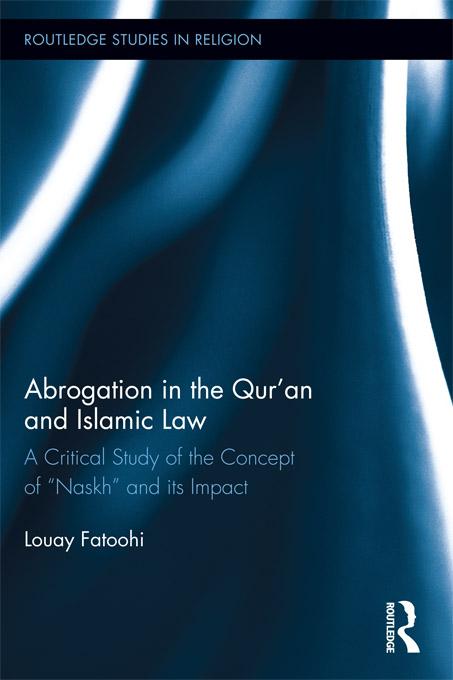
This book examines in detail the concept of "abrogation" in the Qur’an, which has played a major role in the development of Islamic law and has implications for understanding the history and integrity of the Qur’anic text. The term has gained popularity in recent years, as Muslim groups and individuals claim that many passages about tolerance in the Qur’an have been abrogated by others that call on Muslims to fight their enemies. Author Louay Fatoohi argues that this could not have been derived from the Qur’an, and that its implications contradict Qur’anic principles. He also reveals conceptual flaws in the principle of abrogation as well as serious problems with the way it was applied by different scholars.
Abrogation in the Qur’an and Islamic Law traces the development of the concept from its most basic form to the complex and multi-faceted doctrine it has become. The book shows what specific problems the three modes of abrogation were introduced to solve, and how this concept has shaped Islamic law. The book also critiques the role of abrogation in rationalizing the view that not all of the Qur’anic revelation has survived in the "mushaf", or the written record of the Qur’an. This role makes understanding abrogation an essential prerequisite for studying the history of the Qur’anic text.
Betal nemt med kort, Klarna, Apple Pay eller Google Pay. Ikke tilfreds? Du har altid 14 dages fortrydelsesret. Læs mere i vores vilkår. Har du spørgsmål, så send os en mail på hello@memmo.org.
Memmo gør det nemmere at studere – uanset hvor du er i verden. Hos os samler du dine kursusbøger og smarte studieværktøjer ét sted: resuméer, quizzer, podcasts og flashcards. Og så er der Ted, din studieven, der svarer på alt, du undrer dig over. Over 50 000 studerende studerer allerede her – bygget til at hjælpe dig med at lære hurtigere og stresse mindre.