
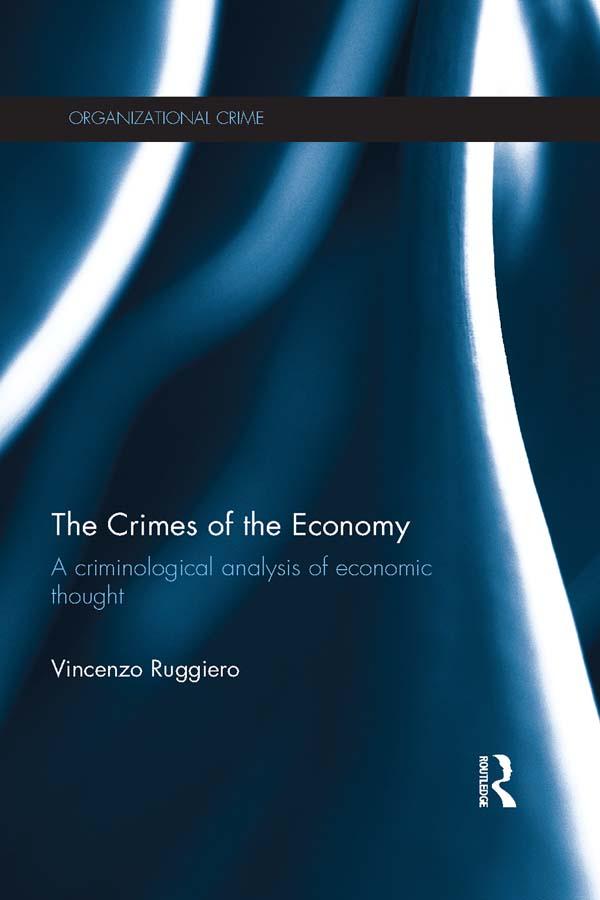
Economists have often paid visits to the field of criminology, examining the rational logic of offending. When economists examine criminal activity, they imply that offenders should be treated like any other social actor making rational choices.
In The Crimes of the Economy, Vincenzo Ruggiero turns the tables by examining a variety of economic schools of thought from a criminological perspective. Each one of these schools, he argues, justifies or even encourages harm produced by economic initiative. He investigates – among others – John Locke’s notion of private property, Mercantilism, the Physiocrats and Malthus, and the arguments of Adam Smith, Marshall, Keynes and neoliberalism. In each of these, the author identifies the potential justification of different forms of ‘crimes of the economy’ and victimisation.
This book re-examines the history of economic thought, assessing it as the history of a discipline which, while attempting to gain scientific status, in reality seeks to make the social harm caused by economics acceptable. The book will be interesting and relevant to students and scholars of social theory, criminology, economics, philosophy and politics.
Betal nemt med kort, Klarna, Apple Pay eller Google Pay. Ikke tilfreds? Du har altid 14 dages fortrydelsesret. Læs mere i vores vilkår. Har du spørgsmål, så send os en mail på hello@memmo.org.
Memmo gør det nemmere at studere – uanset hvor du er i verden. Hos os samler du dine kursusbøger og smarte studieværktøjer ét sted: resuméer, quizzer, podcasts og flashcards. Og så er der Ted, din studieven, der svarer på alt, du undrer dig over. Over 50 000 studerende studerer allerede her – bygget til at hjælpe dig med at lære hurtigere og stresse mindre.