
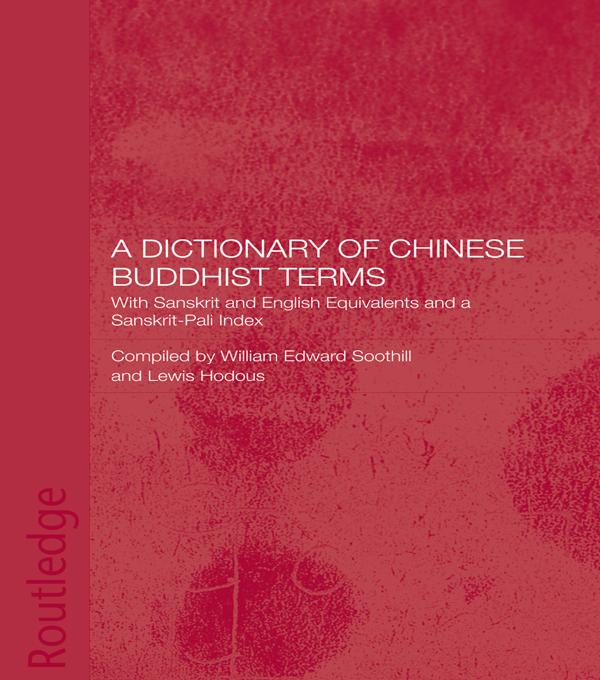
This invaluable interpretive tool, first published in 1937, is now available for the first time in a paperback edition specially aimed at students of Chinese Buddhism.
Those who have endeavoured to read Chinese texts apart from the apprehension of a Sanskrit background have generally made a fallacious interpretation, for the Buddhist canon is basically translation, or analogous to translation. In consequence, a large number of terms existing are employed approximately to connote imported ideas, as the various Chinese translators understood those ideas. Various translators invented different terms; and, even when the same term was finally adopted, its connotation varied, sometimes widely, from the Chinese term of phrase as normally used by the Chinese.
For instance, klésa undoubtedly has a meaning in Sanskrit similar to that of, i.e. affliction, distress, trouble. In Buddhism affliction (or, as it may be understood from Chinese, the afflicters, distressers, troublers) means passions and illusions; and consequently fan-nao in Buddhist phraseology has acquired this technical connotation of the passions and illusions. Many terms of a similar character are noted in the body of this work. Consequent partly on this use of ordinary terms, even a well-educated Chinese without a knowledge of the technical equivalents finds himself unable to understand their implications.
Betal nemt med kort, Klarna, Apple Pay eller Google Pay. Ikke tilfreds? Du har altid 14 dages fortrydelsesret. Læs mere i vores vilkår. Har du spørgsmål, så send os en mail på hello@memmo.org.
Memmo gør det nemmere at studere – uanset hvor du er i verden. Hos os samler du dine kursusbøger og smarte studieværktøjer ét sted: resuméer, quizzer, podcasts og flashcards. Og så er der Ted, din studieven, der svarer på alt, du undrer dig over. Over 50 000 studerende studerer allerede her – bygget til at hjælpe dig med at lære hurtigere og stresse mindre.