
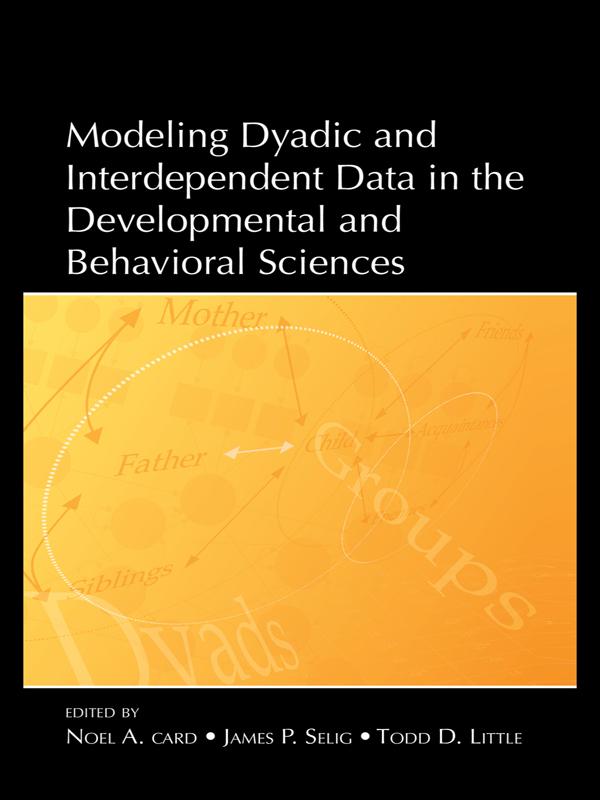
This book reviews methods of conceptualizing, measuring, and analyzing interdependent data in developmental and behavioral sciences. Quantitative and developmental experts describe best practices for modeling interdependent data that stem from interactions within families, relationships, and peer groups, for example. Complex models for analyzing longitudinal data, such as growth curves and time series, are also presented.
Many contributors are innovators of the techniques and all are able to clearly explain the methodologies and their practical problems including issues of measurement, missing data, power and sample size, and the specific limitations of each method.
Featuring a balance between analytic strategies and applications, the book addresses:
- The Actor-Partner Interdependence Model for analyzing influence between two individuals
- The Intraclass Correlational Approach for analyzing distinguishable roles (parent-child) or exchangeable (same-sex) dyadic data
- The Social Relations Model for analyzing group interdependency
- Social Network Analysis approaches for relationships between individuals
This book is intended for graduate students and researchers across the developmental, social, behavioral, and educational sciences. It is an excellent research guide and a valuable resource for advanced methods courses.
Betal nemt med kort, Klarna, Apple Pay eller Google Pay. Ikke tilfreds? Du har altid 14 dages fortrydelsesret. Læs mere i vores vilkår. Har du spørgsmål, så send os en mail på hello@memmo.org.
Memmo gør det nemmere at studere – uanset hvor du er i verden. Hos os samler du dine kursusbøger og smarte studieværktøjer ét sted: resuméer, quizzer, podcasts og flashcards. Og så er der Ted, din studieven, der svarer på alt, du undrer dig over. Over 50 000 studerende studerer allerede her – bygget til at hjælpe dig med at lære hurtigere og stresse mindre.